In Vadodara, Gujarat, at the end of a grand driveway flanked by gardens, stands a structure so large it would swallow Buckingham Palace four times over. Laxmi Vilas Palace — built in 1890 by Maharaja Sayajirao Gaekwad III at a cost of ₹27 lakhs, then equivalent to £180,000 — remains the official residence of the Gaekwad royal family of Baroda. It is one of the largest private residences in the world, and unlike most palaces of comparable scale, it is still lived in. The current occupant, HRH Samarjitsinh Gaekwad, his wife Radhikaraje, and their family continue the unbroken Gaekwad lineage in the same rooms their ancestors commissioned.
For visitors, the portions open to public viewing reveal a palace that was not merely large but extraordinarily refined — the Darbar Hall with its Venetian mosaic floor and Belgian stained glass windows, galleries of Raja Ravi Varma paintings, an armour and weapons collection, and the Maharaja Fateh Singh Museum, all within a 700-acre estate that still contains mango orchards, a zoo section, a 10-hole golf course, and several subsidiary palaces.
Laxmi Vilas Palace Ticket Price 2026 — Official Entry Fee
| Category | Price |
| Indian Citizens | ₹250 per person |
| Foreign Visitors | ₹525 per person |
What’s included: Entry to the palace museum, the Maharaja Fateh Singh Museum, the accessible palace areas, and an audio tour (included with the ticket) that guides visitors through the palace’s history, architecture, and collections.
Photography: Permitted in designated areas. Restrictions apply inside the museum and certain heritage sections. A separate fee may apply for professional cameras or video filming.
Golf: The 10-hole golf course on the palace estate is accessible separately, often for an additional fee. Enquire at the palace office.
Private tours: Guided tours provide deeper historical context and are available separately — contact the palace management at lvpbooking.gaekwarenterprise.com.
Laxmi Vilas Palace — Quick Overview
| Detail | Information |
| Full Name | Laxmi Vilas Palace (Lukshmi Villas Palace / Lakshmi Vilas Palace) |
| Address | Gate No. 2, Laxmi Vilas Palace Estate, J.N. Marg, Moti Baug, Vadodara, Gujarat – 390001 |
| Website / Booking | lvpbooking.gaekwarenterprise.com |
| Built | 1890 |
| Commissioned By | Maharaja Sayajirao Gaekwad III |
| Architects | Major Charles Mant (primary); R.F. Chisholm (completing architect) |
| Area | 700 acres (estate); palace structure ~50,000 sq ft |
| Style | Indo-Saracenic (blending Hindu, Mughal, Gothic) |
| Open Days | Tuesday to Sunday (closed every Monday) |
| Timings | 9:30 AM – 5:00 PM (lunch break 1:00 PM – 1:30 PM) |
| Indian Entry Fee | ₹250 per person |
| Foreign Entry Fee | ₹525 per person |
| Audio Tour | Included with entry |
| Distance from Vadodara Railway Station | ~4 km |
| Distance from Vadodara Airport | ~7–8 km |
| Current Residents | HRH Samarjitsinh Gaekwad and family |
Laxmi Vilas Palace Timings 2026
| Day | Timing |
| Tuesday to Sunday | 9:30 AM – 5:00 PM |
| Lunch Break | 1:00 PM – 1:30 PM |
| Monday | Closed (weekly holiday) |
| Public Holidays | Closed on select public holidays — verify before visiting |
Recommended visiting window: 10:30 AM to 12:00 PM — the palace receives good morning light, crowds are manageable, and the audio tour guide narration is clear without the afternoon rush.
History — The Palace That Dwarfs Buckingham
Maharaja Sayajirao Gaekwad III — The Visionary
Sayajirao Gaekwad III (reigned 1875–1939) was among the most progressive rulers of 19th-century India. Under his rule, Baroda State became known for:
- Universal primary education (compulsory primary education was introduced in Baroda in 1893 — before most Indian states and ahead of most European countries)
- Abolition of sati and child marriage
- Opening of state universities and libraries
- Appointment of Dr. B.R. Ambedkar for higher education (Ambedkar’s postgraduate studies were sponsored by Baroda State)
- Modernisation of Vadodara city with planned boulevards, public gardens, and cultural institutions
The palace was his statement of ambition — a building that would equal or surpass the great palaces of Europe while expressing an Indian architectural identity.
The Architecture
Major Charles Mant began the design in 1878, but died before its completion. Robert Fellows Chisholm completed the building, which took 12 years to construct (1878–1890).
Indo-Saracenic style is the defining architectural choice — a hybrid developed by British architects working in India that combined:
- Hindu elements: Chhatris (domed kiosks), ornamental brackets, carved screens
- Mughal elements: Onion domes, arched iwans, formal garden layout
- Gothic elements: Pointed arches, stained glass, flying buttresses at certain junctions
- Renaissance elements: Colonnaded entrance halls, formal proportions
The resulting structure is simultaneously familiar and unprecedented — it reads as Indian architecture but at a European palace scale, with features from both traditions working in compositional harmony.
Scale: The main building alone covers approximately 50,000 square feet of floor space. The estate extends to 700 acres, incorporating:
- The main palace (museum and official areas)
- Moti Baug garden
- Kirti Mandir (cenotaph of the Gaekwad family)
- A zoo section (currently housing crocodiles, peacocks, and birds)
- A 10-hole golf course
- Several subsidiary palaces
- A small internal railway network once used within the grounds
- Mango orchards
What to See at Laxmi Vilas Palace
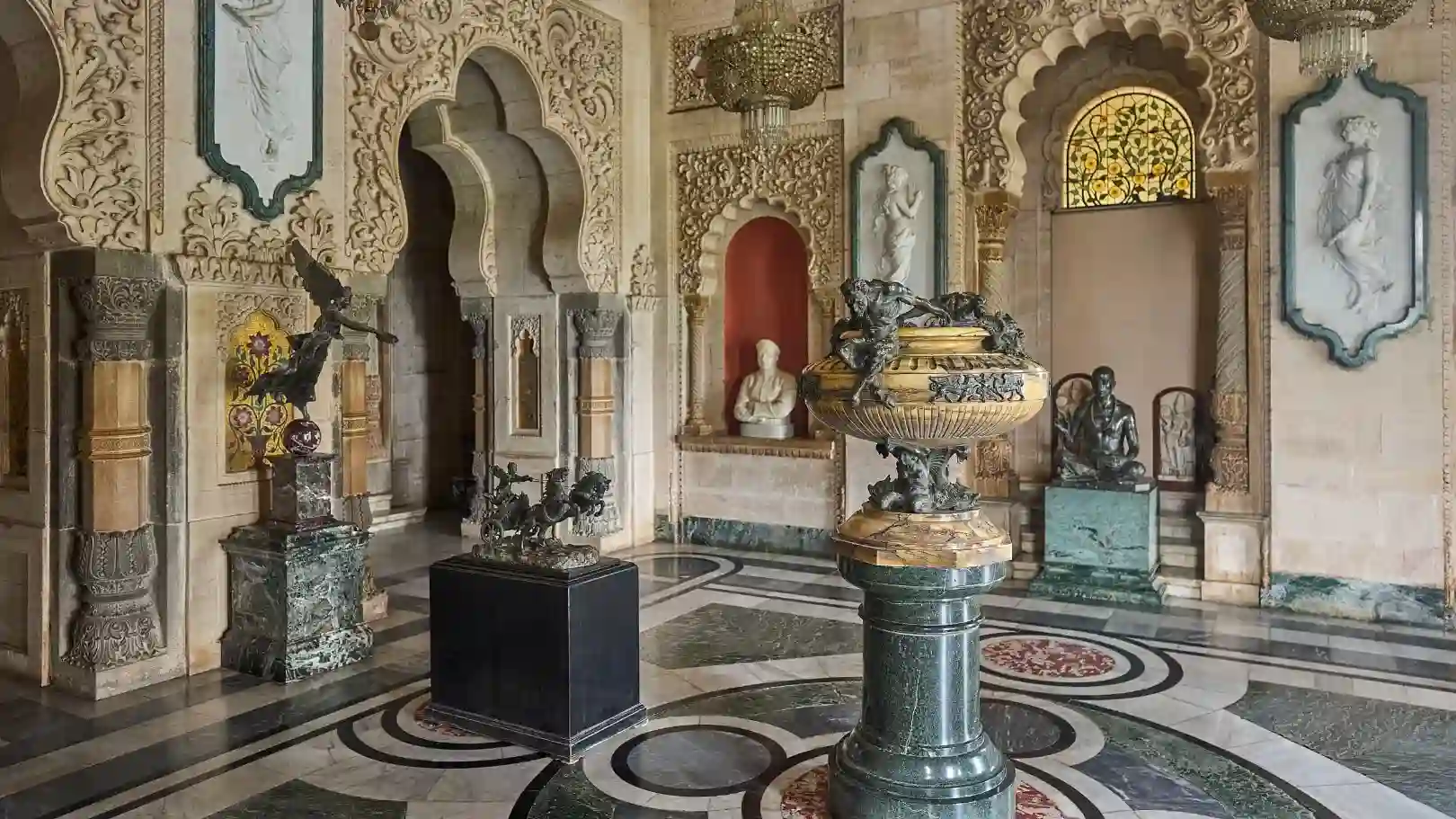
The Darbar Hall
The ceremonial audience hall is the palace’s most dramatic interior. Key features:
- Venetian mosaic floor — imported from Venice; the geometric patterns cover the hall’s full surface in an intricate composition
- Belgian stained glass windows — colour-filtered natural light creates shifting atmospheric effects throughout the day
- Vintage Belgian chandeliers — original to the 1890 interior; multi-tiered, with thousands of crystal pendants
- Carved wooden ceilings — coffered and decorated in the Mughal-influenced style typical of 19th-century Baroda craftwork
- Scale: The hall was designed for formal state occasions — the scale of the space is immediately apparent
The Darbar Hall is the most photographed interior at the palace, though photography restrictions in certain sections may apply — verify on arrival.
Maharaja Fateh Singh Museum
A dedicated museum within the palace complex housing the personal collections of the Gaekwad dynasty. Key exhibits:
Raja Ravi Varma paintings: The museum holds one of India’s finest collections of original works by Raja Ravi Varma (1848–1906), the artist who created the defining visual language of Hindu mythology in painting and whose lithographs became the most widely reproduced Indian artworks of the 20th century. Several commissioned works depicting Gaekwad family members and mythological subjects are displayed. Original Ravi Varma canvases are rarely accessible to the public — this collection is a primary reason to visit.
European sculptures and paintings: A significant collection of European art acquired by Maharaja Sayajirao during his travels — paintings, bronze figures, marble busts — representing the Gaekwad dynasty’s active engagement with international art markets.
Royal memorabilia and artefacts: Personal items belonging to the Gaekwad rulers across generations.
Arms and armour collection: Swords, ceremonial weapons, and armour collected by the Maharaja personally — a significant assembly spanning Indian, Persian, and European military craftsmanship.
The Palace Grounds and Gardens
Moti Baug (Pearl Garden): The formal gardens adjacent to the main palace building, with ornamental planting and views of the palace facades from different angles.
The Zoo Section: A surviving fragment of the original palace zoo, now housing crocodiles in a pond setting and large populations of peafowl that roam freely through the garden areas. The peacocks of Laxmi Vilas Palace are one of the unremarked pleasures of the visit — multiple birds visible in the grounds at any given time, particularly in the early morning.
The Golf Course: A 10-hole course within the palace grounds, accessible to visitors for play (separate fee). The experience of playing golf in the grounds of an active royal residence is genuinely unusual.
Internal Railway: A small narrow-gauge railway network once connected sections of the 700-acre estate. Parts of the track are visible on the grounds.
The Palace Exterior
The exterior is best appreciated from the main approach — the Indo-Saracenic facade, with its central dome, corner towers, and intricate surface decoration, rewards slow examination. The proportional scale that allows each element to remain readable despite the building’s overall size is the principal achievement of the architects.
Online Ticket Booking
Book online at lvpbooking.gaekwarenterprise.com — the official Gaekwar Enterprise booking portal. Login requires a mobile number for OTP verification. Pre-booking helps avoid counter queues, particularly on weekends and tourist-season weekdays.
How to Reach Laxmi Vilas Palace
Address: Gate No. 2, Laxmi Vilas Palace Estate, J.N. Marg (Jawaharlal Nehru Marg), Moti Baug, Vadodara, Gujarat.
By Rail: Vadodara Junction (Baroda Railway Station) is approximately 4 km from the palace — 10 to 15 minutes by auto-rickshaw or cab (₹60–₹100). Vadodara is well-connected to Mumbai (2 hours by Shatabdi), Ahmedabad (1 hour), Delhi (8 hours by superfast), and Surat (1 hour).
By Air: Vadodara Airport is approximately 7 to 8 km from the palace — 20 to 25 minutes by cab. Domestic flights connect Vadodara to Mumbai, Delhi, Bengaluru, and Hyderabad.
By Road: On J.N. Marg in central Vadodara — easily navigated by cab, auto-rickshaw, or Ola/Uber. Set destination “Laxmi Vilas Palace Gate 2.”
Parking: Available at the palace for private vehicles.
Nearby Attractions in Vadodara
| Attraction | Distance | Type |
| Kirti Mandir | Within estate | Gaekwad family cenotaph |
| Sayaji Baug (Kamati Baug) | ~2 km | Public garden, zoo, museum |
| Baroda Museum & Picture Gallery | ~2 km | Art and natural history |
| Nazarbaug Palace | ~3 km | Earlier Gaekwad residence |
| Champaner-Pavagadh (UNESCO WHS) | ~47 km | 15th-century fortified city |
| Vadodara Museum of Art (Baroda Museum) | ~2 km | Fine arts collection |
Best Time to Visit
October to February (Winter): Ideal. Vadodara’s winter is pleasant (15°C to 28°C) and the outdoor gardens are most comfortable. The palace interiors are also more inviting without summer heat.
Morning visits (10:30 AM – 12:30 PM): The Darbar Hall and palace interior receive the best natural light in the late morning. Audio tour narration is clearest before afternoon tour groups arrive.
Avoid Mondays: The palace is closed every Monday.
Frequently Asked Questions
Q1. What is the Laxmi Vilas Palace ticket price in 2026?
₹250 for Indian citizens; ₹525 for foreign visitors. Both include access to the palace museum, the Maharaja Fateh Singh Museum, the accessible palace areas, and an audio tour.
Q2. What are Laxmi Vilas Palace timings?
9:30 AM to 5:00 PM, Tuesday to Sunday. Closed every Monday. Lunch break from 1:00 PM to 1:30 PM. Last entry approximately 4:30 PM.
Q3. Is Laxmi Vilas Palace still a private residence?
Yes. The Gaekwad family (HRH Samarjitsinh Gaekwad and family) continues to live in the palace. The areas open to the public are the designated museum and heritage sections — not the private residential portions.
Q4. What is the most significant artwork at Laxmi Vilas Palace?
The Maharaja Fateh Singh Museum houses one of India’s finest collections of original Raja Ravi Varma paintings — commissioned works by the Gaekwad dynasty. Genuine Ravi Varma originals are extremely rare in public display; this collection is exceptional.
Q5. How large is Laxmi Vilas Palace compared to Buckingham Palace?
Laxmi Vilas Palace is consistently cited as four times the size of Buckingham Palace. Buckingham Palace covers approximately 77,000 square metres of floor space across its buildings; Laxmi Vilas Palace’s 700-acre estate encompasses a larger total footprint, though exact floor area comparisons depend on which structures are included in the calculation.