India’s first optical illusion museum sits on the first floor of a Connaught Place building — a five-minute walk from Rajiv Chowk metro station, in the middle of Delhi’s most central commercial district. The Museum of Illusions Delhi opened in 2020 as the Indian branch of a Croatian chain that now operates in 40+ cities worldwide, and it has become one of the capital’s most consistently popular indoor attractions — partly because it is genuinely entertaining, partly because it is one of the most photographable spaces in Delhi, and partly because it is unusual enough that it feels like a genuine discovery even in a city as large as Delhi.
The premise is simple: 50+ exhibits designed using principles of science, psychology, and optics to comprehensively trick your brain. You walk in expecting to feel smart. You leave questioning everything you saw. The photo opportunities along the way are consistently spectacular.
Museum of Illusions Ticket Price 2026 — Official Entry Fee
Prices vary slightly between weekday and weekend visits:
Weekday (Monday–Friday)
| Category | Price |
| Adults | ₹650 – ₹696 per person |
| Children (3–11 years) | ₹524 – ₹550 per person |
| Senior Citizens | ₹649 per person |
| Foreign Nationals | ~₹1,050 per person |
| Children below 3 years | Free |
Weekend (Saturday–Sunday)
| Category | Price |
| Adults | ₹690 – ₹850 per person |
| Children (3–11 years) | ₹550 – ₹690 per person |
| Senior Citizens | ~₹649 per person |
| Foreign Nationals | ~₹1,050 per person |
| Children below 3 years | Free |
Note: Prices above reflect the consistent range across multiple verified 2025–2026 sources. Exact current pricing may vary slightly. Book via the official website at museumofillusions.in or authorised platforms including BookMyShow, Thrillophilia, and District.in to confirm the live rate.
The museum is completely cashless — all payments online or by card at the venue.
Tickets are non-refundable but can be rescheduled within 30 days subject to slot availability.
Online booking is strongly recommended, especially for weekends, as time slots sell out.
Museum of Illusions Delhi — Quick Overview
| Detail | Information |
| Full Name | Museum of Illusions — New Delhi |
| Address | A 30-33, 1st Floor, A Block, Inner Circle, Connaught Place, New Delhi – 110001 |
| Nearest Metro | Rajiv Chowk (Yellow Line + Blue Line) — Exit Gate No. 8 — ~2-minute walk |
| Website | museumofillusions.in |
| Booking Platforms | museumofillusions.in, BookMyShow, District.in, Thrillophilia |
| Open Days | All 7 days |
| Weekday Timings | 11:00 AM – 8:00 PM |
| Weekend Timings | 11:00 AM – 8:30 PM |
| Visit Duration | 60–90 minutes |
| Adult Ticket (Weekday) | ₹650–₹696 |
| Adult Ticket (Weekend) | ₹690–₹850 |
| Children below 3 | Free |
| Foreign Nationals | ~₹1,050 |
| Photography | Permitted and encouraged throughout |
| Wheelchair Accessible | No — not fully wheelchair accessible |
| Payment | Cashless only |
Museum of Illusions Timings 2026
| Day | Opening | Closing |
| Monday to Friday | 11:00 AM | 8:00 PM |
| Saturday and Sunday | 11:00 AM | 8:30 PM |
Open all 365 days — no weekly holiday and no seasonal closure. Being fully indoors and air-conditioned, it operates comfortably through Delhi’s summer heat (May–June) when most outdoor attractions become difficult to visit.
History — India’s First Optical Illusion Museum
The Museum of Illusions global chain was founded in Zagreb, Croatia, in 2015 by Roko and Renata Prišlić. The concept grew rapidly — by 2026, the chain operates in over 40 cities worldwide including New York, Dubai, Vienna, and Singapore. The Delhi branch, which opened in February 2021, was India’s first Museum of Illusions location.
The chain’s success rests on a specific formula: interactive optical illusions that work best in groups (because the exhibits produce visible effects when friends photograph each other inside them) and that generate inherently shareable social media content. The Delhi branch built its audience partly on Instagram and YouTube — the rotating Vortex Tunnel, the size-distorting Ames Room, and the infinity-mirror Kaleidoscope Room all produce photographs that visually defy explanation and drive organic word-of-mouth.
The 50+ Exhibits
Room-Scale Illusion Experiences
Ames Room — The museum’s most-photographed single exhibit. Two people standing in opposite corners of this specially distorted room appear to have dramatically different heights — one appears to be a giant, the other a dwarf. The optical trick uses forced perspective: the room’s walls and ceiling are built at severely angled dimensions that, from the observation window, create an appearance of a normal rectangular room. The result is a photograph where two friends of identical height appear to differ by a metre.
Vortex Tunnel — A long walkway through a slowly rotating cylindrical structure. The floor (a bridge) is perfectly stable. The rotating cylinder around you tricks your brain into perceiving that you are rolling, spinning, or falling. Most visitors feel genuine vertigo despite standing on solid ground. Duration approximately 30 seconds each pass-through — but most visitors go back for repeated attempts. Not recommended for visitors with vertigo, motion sickness, claustrophobia, epilepsy, or inner ear conditions.
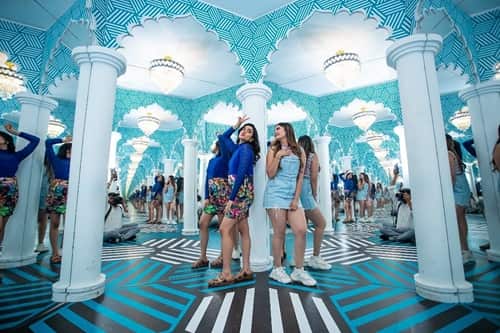
Infinity Room / Kaleidoscope Room — A mirrored room where reflections produce an apparent infinite corridor of light in all directions. The visual effect of standing within an apparently endless space is distinctly different from looking at photographs of the room — the immersive quality requires being inside it.
Tilted Room — A room where the floor and walls are built at a significant angle to true horizontal. Standing inside creates a disorienting off-balance feeling even with full knowledge of the trick. Walking through requires conscious compensation for the angled floor.
Anti-Gravity Zone / Upside Down Room — A room where all the furniture and fittings are mounted on the ceiling. Visitors stand on a normal floor and photograph upward — but when the photo is flipped, they appear to be standing on the ceiling surrounded by normal furniture. One of the most reliably effective photo illusion exhibits in the museum.
Tilted House Exterior Shoot — A photo set designed for full-body perspective illusions where people appear to be running up vertical walls, hanging from ceilings, or defying gravity in various configurations.
Perception Illusions
Hollow Face Illusion — A concave face mask that appears to convex (protrude outward) when viewed from the front. The brain’s experience of faces is so strong that it overrides the physical reality of the mask’s curvature — the hollow face always looks like it is looking at you. Moving side to side appears to make the face follow your movement.
Moving Optical Illusions Wall — Flat patterns that appear to pulse, rotate, or move when stationary. These exploit the way the visual system processes contrast and spatial frequency.
Bistable Images — Classic optical illusions (the duck-rabbit, the young woman-old woman, the Necker cube) displayed at large scale with interactive elements.
Colour Afterimage Wall — Stare at a specific coloured pattern, then look at a white wall — you see a vivid afterimage in complementary colours. The neuroscience behind it is explained on the exhibit panel.
Holograms and 3D Art
Hologram Collection — Multiple holographic images that appear three-dimensional and seem to change as you move around them. Some holograms appear to vanish from certain angles. The physics of holography (wavefront reconstruction) is explained alongside the displays.
Stereograms — “Magic Eye” style flat images that contain hidden 3D images visible only when the eyes are defocused. Visitors often need several minutes and staff assistance to see their first stereogram — the moment it becomes visible is reliably thrilling.
Anamorphic Art — Flat floor paintings that appear to be three-dimensional objects when photographed from a specific angle. These create dramatic “I’m standing on the edge of a cliff” or “a giant is pulling me into the floor” type photographs.
Smart Playroom — Games and Puzzles
A dedicated section with logic puzzles, building challenges, and brain games:
Impossible Objects: Physical objects (Penrose triangle, impossible cube, necker illusion made solid) that appear impossible but exist through carefully engineered perspective. They only look “impossible” from one specific viewing angle.
Mathematical Games and Puzzles: Topological challenges, Möbius strips, rope tricks, puzzle locks.
Building Block Challenges: Tangrams, pattern completion, and spatial reasoning exercises.
IQ Test Walls: Series of pattern-recognition and spatial reasoning exercises in displayed format.
Card and Number Magic Explained: The mathematical principles behind common card tricks displayed interactively.
Selfie and Photo Illusions Gallery
Head on a Platter — A photo set where you lie inside a table-height box with a hole for your head, and your body is concealed — the photograph appears to show your severed head resting on a platter. One of the museum’s most queued-for exhibits.
Giant and Miniature Sets — Photo sets where ordinary objects are scaled unusually (giant pencil, tiny furniture) to create forced-perspective photographs where visitors appear to be a different size relative to their surroundings.
Cartoon and Animated Backgrounds — Photo walls with illustrated backgrounds that make visitors appear to be inside comic books, anime scenes, or animated environments.
Facilities
| Facility | Detail |
| Small Café | Light snacks and beverages; outside food not permitted |
| Smart Shop | Illusion toys, optical puzzles, souvenirs, and magic-related merchandise |
| Restrooms | Clean, well-maintained |
| Photography | Encouraged throughout; staff help with posing at each exhibit |
| Re-entry | Not permitted once exited |
Staff assistance: Museum staff at key exhibits will actively help visitors find the optimal position for photographs, explain the science behind each illusion, and assist with posing. This is one of the most consistently praised aspects of the museum in visitor reviews.
How to Reach Museum of Illusions Delhi
By Metro (Recommended):
Rajiv Chowk Metro Station (Yellow Line + Blue Line interchange) — Exit Gate No. 8 — approximately 2-minute walk to the museum.
From Rajiv Chowk exit 8, walk along the Inner Circle of Connaught Place counterclockwise to Block A. The museum is on the 1st floor of A 30-33, clearly signposted.
By Road:
Located in Connaught Place — one of Delhi’s best-connected commercial hubs. Ola, Uber, and autos reach it from anywhere in Delhi. Set destination “Museum of Illusions Connaught Place” for accurate navigation.
Parking:
Municipal Corporation of Delhi (MCD) parking available at CP at ₹20 per hour. On weekdays this is manageable; weekends see significant congestion in the CP area.
Nearby Attractions
The CP location clusters the museum naturally with:
- Jantar Mantar — 500 metres; Mughal-era astronomical instruments; ₹25 entry
- Agrasen ki Baoli — 800 metres; ancient stepwell; free entry
- Gurudwara Bangla Sahib — 900 metres; major Delhi Sikh shrine; free
- Connaught Place itself — shopping, cafés, restaurants immediately adjacent
- National Museum — 2 km; India’s largest archaeological collection
Best Time to Visit
Year-round: The museum is fully indoor and air-conditioned — a rare Delhi attraction that is equally comfortable in the 45°C June heat and the 5°C December cold.
Weekdays (any time): Lower crowds mean shorter queues at popular exhibits (particularly the Ames Room and Vortex Tunnel, which can have 10–15 minute waits on weekends). Weekday tickets are also marginally cheaper.
Morning opening (11:00 AM–1:00 PM weekdays): The quietest window of the week. Staff have more time for each group.
Avoid: Saturday and Sunday afternoons (2:00 PM–6:00 PM) during school holidays — peak crowd intensity makes the photo illusions less accessible as queues at key exhibits extend.
Visitor Tips
- Carry a fully charged phone — almost every exhibit produces a photographable moment
- Staff will pose alongside you and photograph your group at key exhibits — accept the offer
- Allow 60 to 90 minutes for a thorough visit; 45 minutes if moving quickly
- Some spinning exhibits (Vortex Tunnel) are not suitable for people with vertigo, motion sickness, claustrophobia, or epilepsy — check exhibit-specific notices before entering
- Not fully wheelchair accessible — visitors with mobility challenges should enquire at the venue
- Book online in advance for weekends; slots sell out
Frequently Asked Questions
Q1. What is the Museum of Illusions Delhi ticket price in 2026?
Weekday adults: ₹650–₹696; children (3–11 yrs): ₹524–₹550. Weekend adults: ₹690–₹850; children: ₹550–₹690. Senior citizens: ~₹649. Foreign nationals: ~₹1,050. Children below 3: free. Book at museumofillusions.in for current rates.
Q2. What are Museum of Illusions Delhi timings?
Monday–Friday: 11:00 AM–8:00 PM. Saturday–Sunday: 11:00 AM–8:30 PM. Open all 7 days year-round.
Q3. Which metro station is nearest to Museum of Illusions Delhi?
Rajiv Chowk Metro Station (Yellow + Blue Line interchange) — Exit Gate No. 8 — approximately 2-minute walk.
Q4. Is photography allowed inside Museum of Illusions Delhi?
Yes. Photography is not only permitted but actively encouraged throughout the museum. Staff at each exhibit will help you find the best angle and take photographs.
Q5. How long does a visit to Museum of Illusions take?
60 to 90 minutes is sufficient for most visitors to see all 50+ exhibits and photograph the key rooms. Families with young children or groups who spend time at each exhibit may take up to 2 hours.