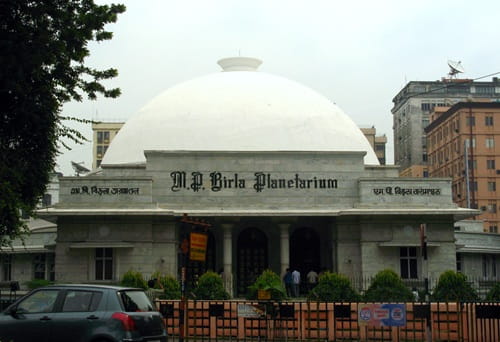
Inside the grounds of Teen Murti Bhavan in Lutyens’ Delhi — where Jawaharlal Nehru lived and worked as India’s first Prime Minister — a dome-shaped building has been quietly turning hundreds of thousands of visitors into temporary astronomers since February 6, 1984. The Nehru Planetarium Delhi is one of five Nehru Planetariums established across India (the others are in Mumbai, Bangalore, Pune, and Prayagraj) under the Jawaharlal Nehru Memorial Fund, set up in 1964 to carry forward Nehru’s deep commitment to scientific thinking and public education.
What the planetarium does is deceptively simple: it takes a dome-shaped ceiling, projects onto it a representation of the sky, and for 35 to 45 minutes turns off the lights and lets the cosmos do the explaining. It is one of the least expensive educational experiences available in Delhi, and one of the most memorable — particularly for children encountering a planetarium for the first time.

Nehru Planetarium Delhi Ticket Price 2026 — Official Entry Fee
The official Nehru Planetarium website (nehruplanetarium.org) confirms the following show ticket prices:
| Category | Price |
| Adults (above 12 years) | ₹50 per person |
| Children (4 to 12 years) | ₹30 per person |
| Children below 4 years | Generally not admitted to shows |
| School Groups (25+ students) | ₹20 per student (concession in public shows) |
| Full Theatre Booking (school groups only, 250 seats) | ₹5,000 (at 9:30 AM or 10:30 AM) |
Tickets can be bought from the SBI Extension Counter (for the 11:30 AM show) and at the Teen Murti Bhawan (inside the planetarium) half an hour before each show timing.
Note on pricing discrepancy: Multiple third-party sources cite ₹100 (adult) and ₹60–₹70 (child) — these may reflect revised pricing or specific show types (2D vs 3D) not captured on the official page. Sky Theatre ticket prices start from ₹100 for adults and ₹60 for children per some updated sources. Verify at the ticket counter on arrival as prices may have been revised since the official page was last updated.
Nehru Planetarium Delhi — Quick Overview
| Detail | Information |
| Full Name | Nehru Planetarium, Teen Murti Bhavan, New Delhi |
| Address | Teen Murti Bhavan, Teen Murti Marg, Chanakyapuri, New Delhi – 110011 |
| Website | nehruplanetarium.org |
| Inaugurated | February 6, 1984 (by PM Indira Gandhi) |
| Open Days | Tuesday to Sunday (closed every Monday) |
| Operating Hours | 11:00 AM – 6:00 PM |
| Show Ticket (Adult) | ₹50 (official) / ₹100 (some sources) |
| Show Ticket (Child 4–12) | ₹30 (official) / ₹60–₹70 (some sources) |
| School Group Concession | ₹20/student (min. 25 students, public shows) |
| Show Duration | 35–45 minutes |
| Sky Theatre Capacity | ~270 seats |
| Annual Visitors | ~2,00,000 |
| Nearest Metro | Lok Kalyan Marg (Yellow Line) / Race Course Road — ~1–1.5 km |
| Photography | Not permitted inside the Sky Theatre |
| Food | Not permitted in theatres |
Show Timings 2026
Show timings at Nehru Planetarium Delhi are:
| Show | Language | Time |
| Sky Show | English | 11:00 AM, 3:00 PM (2D) |
| Sky Show | English | 2:00 PM, 6:00 PM (3D) |
| Sky Show | Hindi | 5:00 PM (2D) |
| Sky Show | Hindi | 12:00 PM, 4:00 PM (3D) |
These timings are based on current available sources and may differ slightly from the schedule board on any given day. Timings of Nehru Planetarium shows are normally 11:30 AM English, 1:30 PM Hindi, 3:00 PM English, and 4:00 PM Hindi per another source — slight variations in schedule are normal. Always check the current schedule board at the ticket counter when you arrive, as schedules can be adjusted for special programmes, maintenance, and public holidays.
Show duration: Each show lasts approximately 35 to 45 minutes. Additional shows may be scheduled on Sundays and public holidays depending on crowd.
Arrive early: Entry inside the Sky Theatre is strictly prohibited once the show has started. Arrive at least 30 minutes before the show timing.
History
The Jawaharlal Nehru Memorial Fund
The Jawaharlal Nehru fund was set up in 1964 to promote the ideas of the beloved leader. The Delhi planetarium was inaugurated on 6 February 1984 by former Prime Minister Indira Gandhi.
Nehru’s interest in science was not merely rhetorical. As Prime Minister, he presided over the establishment of the Indian Institutes of Technology, the Atomic Energy Commission, the Indian Space Research Organisation (ISRO, then the Indian National Committee for Space Research), and a dozen other foundational scientific institutions. The planetarium built in his name reflects the same impulse — making cosmic science accessible to ordinary people rather than restricting it to academic specialists.
Location Within Teen Murti Estate
Teen Murti Bhavan is itself significant historical ground. The building served as Nehru’s official residence from 1947 until his death in 1964, and is now a national museum preserving his personal study, bedroom, and public reception rooms. The planetarium in the grounds is thus embedded within a living memorial — visiting the planetarium can naturally be combined with a free tour of Teen Murti Bhavan and the Pradhanmantri Sangrahalaya (Prime Ministers’ Museum), which opened in 2022 on the same estate.
Renovation and Upgrade (2010)
Nehru Planetarium Delhi was closed for renovations costing around ₹11 crore. It was reopened for the general public in 2010 with some interesting new additions. One of the major additions was the Definiti optical star projector “Megastar” — with this device, one can see as many as 2 million stars at the same time.
Owing to its magnificence, Nehru Planetarium was the recipient of the Queen’s Baton during the Commonwealth Games relay — a recognition of its status as a significant public institution in Delhi.
The Sky Theatre — What to Expect
The Sky Theatre is a dome-shaped structure with the screen forming the entire ceiling and upper walls — essentially placing the audience inside a hemisphere that becomes the sky. The dome-shaped theatre creates an immersive star-field experience. Show duration is approximately 35 to 45 minutes. Seats available: approximately 270 (book early for weekend shows).
Inside, the lights dim fully and the projection begins — typically starting with Earth’s night sky before moving outward through the solar system, into the galaxy, and sometimes toward cosmological scales. The narration (in Hindi or English depending on the show) explains what is being shown, makes the science accessible for a general audience, and creates a sustained sense of wonder through the quality of the imagery.
The Sky Theatre is a dome-shaped theatre which has been built in a way that replicates the sky as it is visible to us.
The experience works exceptionally well for children in the 6 to 14 age range — many adults visiting as parents comment that the planetarium show was the most engaged they had seen their children all day.
Exhibits and Displays
Exhibition Gallery
The Exhibition Gallery of the planetarium is home to a rich collection of paintings, historic images of celestial bodies, and trivia about outer space. One can gain invaluable insights on space voyages of astronauts as encapsulated in various forms of visuals.
The gallery provides free educational context for visitors before or after the show — particularly useful for school groups whose visit combines the show with exhibit-based learning.
Soyuz T-10 Space Capsule — The Rakesh Sharma Exhibit
The most historically significant exhibit at the planetarium. Soyuz T-10 was used by Rakesh Sharma, the first Indian cosmonaut, to travel to space. The Nehru Planetarium gives a glimpse of his journey with his mission journal and his space suit.
Rakesh Sharma flew to the Soviet Salyut 7 space station in April 1984 — the same year the planetarium opened — aboard the Soyuz T-11 (the capsule designation in official records is Soyuz T-11, though some sources cite T-10). His mission lasted 7 days, 21 hours, and 40 minutes. The space suit, mission journal, and capsule displayed at Nehru Planetarium make this a genuinely significant space heritage exhibit.
Megastar Projector and Telescopes
The establishment is well endowed with state-of-the-art telescopes, solar filters, and projectors with which one can view almost 2 million stars and experience the vastness of outer space.
During solar eclipses and significant astronomical events, the planetarium makes solar filters and projection equipment available for public viewing — a practice that has made Nehru Planetarium a focal point for eclipse observation events in Delhi.
Interactive Science Exhibits
Interactive models — touch-and-learn exhibits of satellites, planets, and space missions. Astronomy workshops for school students covering telescope making, stargazing, and science quiz sessions.
Educational Programmes
Nehru Planetarium Delhi runs structured educational activities beyond the standard sky shows:
Astronomy Quizzes: Astronomy quizzes and art competitions are held every year in February and August which one can participate in.
School Group Bookings: Planetarium can be requested for a full theatre booking for a group of 250 seats at a highly concessional rate of ₹5,000 for school groups only, at 9:30 AM and 10:30 AM. Other special group bookings could be conditionally considered at these times or at 12:30 PM, 2:15 PM, or 4:45 PM, depending on availability.
Telescope Making and Stargazing Workshops: Available for school students through prior booking — contact the planetarium directly.
How to Reach Nehru Planetarium Delhi
Address: Teen Murti Bhavan, Teen Murti Marg, Chanakyapuri, New Delhi – 110011.
By Metro (Recommended): Central Secretariat and Lok Kalyan Marg are among the nearest metro stations — both on the Yellow Line, approximately 1 to 1.5 km from the planetarium. E-rickshaws and autos are available at both stations.
Race Course Road Metro Station (Yellow Line) is also frequently cited — approximately 1.5 km from Teen Murti Bhavan.
By Bus: DTC buses play to and from Nehru Planetarium at frequent intervals. Bus numbers 680, 720, 615, and 604 serve the route.
By Cab: Set destination “Nehru Planetarium Teen Murti Bhavan” on Ola/Uber. Located in Chanakyapuri — well within the central Delhi cab network.
Parking: Available within the Teen Murti Estate.
Nearby Attractions
The Teen Murti Bhavan location clusters the planetarium naturally with several significant Delhi attractions:
| Attraction | Distance | Type |
| Teen Murti Bhavan Museum | Same campus | Nehru’s residence turned national museum |
| Pradhanmantri Sangrahalaya | Same campus | Interactive Prime Ministers’ Museum (2022) |
| India Gate | ~3 km | National monument |
| National Museum | ~3 km | India’s largest archaeological collection |
| Rashtrapati Bhavan | ~2.5 km | President’s Palace (Amrit Udyan open seasonally) |
| Lodhi Garden | ~4 km | Free heritage garden |
Best Time to Visit
October to February: Delhi weather is pleasant during October to March and it is ideal to walk around the Teen Murti grounds before or after the show.
Weekday mornings: The best day is weekday Tuesday to Thursday. On weekends, a lot of families and school groups get to the theatre and shows sell out. The least crowded time is the morning show at 11:30 AM.
School visits: The 9:30 AM and 10:30 AM special school slots offer a quieter, more structured experience for student groups. Prior booking mandatory.
Visitor Rules
- No entry inside the Sky Theatre once show has started — arrive 30 minutes early
- No photography or videography inside the theatre
- No food inside theatres
- Photography is allowed in selected areas outside the dome theatre
- Children below 4 generally not admitted to shows (confirm at counter)
- Air-conditioned premises throughout
Frequently Asked Questions
Q1. What is the Nehru Planetarium Delhi ticket price in 2026?
The official website lists ₹50 per adult (above 12 years) and ₹30 per child (4–12 years) for the sky show. Some updated sources cite ₹100 adult / ₹60–₹70 child, which may reflect revised pricing or 3D show premiums. Verify at the counter on arrival. School groups: ₹20/student (min. 25 students).
Q2. What are Nehru Planetarium show timings?
English shows: 11:00 AM and 3:00 PM (2D); 2:00 PM and 6:00 PM (3D). Hindi shows: 5:00 PM (2D); 12:00 PM and 4:00 PM (3D). Verify the day’s current schedule at the ticket counter.
Q3. Is Nehru Planetarium open on Mondays?
No. The planetarium is closed every Monday. Open Tuesday to Sunday, 11:00 AM to 6:00 PM.
Q4. Which metro station is nearest to Nehru Planetarium Delhi?
Lok Kalyan Marg or Central Secretariat on the Yellow Line — approximately 1 to 1.5 km from Teen Murti Bhavan. Race Course Road (Yellow Line) is also nearby.
Q5. Can school groups book the entire theatre at Nehru Planetarium?
Yes. A full theatre booking for school groups (250 seats) is available at ₹5,000 for the 9:30 AM and 10:30 AM time slots. Other special group bookings can be conditionally arranged at 12:30 PM, 2:15 PM, or 4:45 PM — contact the planetarium directly.