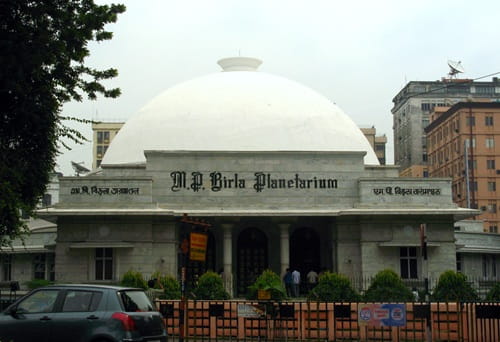
On Jawaharlal Nehru Road, between Victoria Memorial and St. Paul’s Cathedral, stands a building that looks unlike anything else in Kolkata. Circular, domed, and modelled on the Buddhist Stupa at Sanchi — the M. P. Birla Planetarium has been sparking genuine curiosity about the universe since it opened in 1962. Asia’s largest planetarium and the second largest in the world, it draws school groups, astronomy enthusiasts, families, and curious travellers to an experience that hasn’t lost its ability to impress even after six decades of shows.
This guide has the official 2026 ticket prices, show timings across all languages, what to expect inside, and everything you need to plan your visit.
Birla Planetarium Kolkata Ticket Price 2026 — Official Rates
Ticket prices are sourced directly from the official M. P. Birla Planetarium website.
| Category | Ticket Price |
| General (Adults) | ₹150 per person |
| Students (group of 25 or more) | ₹100 per person |
| Children below 3 years | Free |
Children aged 3 years and above are charged at the full general rate. Student group rates apply only to organised groups of 25 or more with valid student identification.
Tickets are available online through BookMyShow and at the planetarium counter. Counter tickets are available half an hour before each show — there is no advance day counter booking for individual visitors.
Birla Planetarium Kolkata — Quick Overview
| Detail | Information |
| Official Name | M. P. Birla Planetarium |
| Address | 96, Jawaharlal Nehru Road, Kolkata – 700 071 |
| Opened to Public | 29 September 1962 |
| Formally Inaugurated | 2 July 1963, by PM Pandit Jawaharlal Nehru |
| Founded By | M. P. Birla (Birla Education Trust) |
| Architectural Style | Based on the Buddhist Stupa at Sanchi |
| Dome Diameter | 23 metres (25 metres per some sources) |
| Seating Capacity | Approximately 570 seats |
| Contact | 91-33-22231516 / 91-33-22236610 |
| info@mpbirlaplanetarium.org | |
| Distinction | Asia’s largest planetarium; second largest in the world |
Show Timings — Birla Planetarium Kolkata 2026
The planetarium is open from 12:00 PM to 6:00 PM, Monday to Sunday. Shows run at multiple slots throughout the day in three primary languages.
| Language | Show Timings |
| Hindi | 12:00 PM, 2:00 PM, 4:00 PM |
| English | 1:00 PM, 6:00 PM |
| Bengali | 3:00 PM, 5:00 PM |
Special shows are conducted on Sundays and public holidays:
- 10:00 AM — Hindi
- 11:00 AM — Bengali
Occasional shows in regional languages including Odia, Tamil, and Gujarati are conducted periodically — check the official website for scheduled regional language show dates.
Each show runs for approximately one hour. Given that tickets are only sold from 30 minutes before each show, arriving at least 45 minutes early during weekends and holidays is advisable — the planetarium has seating for 570 visitors and popular shows fill up quickly.
Current Shows at M. P. Birla Planetarium
The planetarium rotates its show schedule periodically. Current and forthcoming shows as of 2026 include:
Our Universe — The most popular show following the 2017 renovation upgrade. Delivered using full dome projection technology, it simulates the experience of travelling through space in a spacecraft. The most sought-after show for both first-time visitors and repeat visitors.
Cosmic Collisions — A thrilling virtual reality-style full dome experience exploring hypervelocity impacts — asteroid strikes, galactic mergers, and the physics of collision events that have shaped the solar system.
Explore — A modern science show built around the ambition to colonise Mars. Covers spacecraft navigation, orbital mechanics, and space science in an engaging story format accessible to non-specialists.
Zodiac Signs and Stars — A classic show examining the constellations that form the zodiac, their mythology, and their real astronomical characteristics.
Journey to the Antarctic — An immersive show about Antarctica, its science stations, and its significance in understanding Earth’s climate and cosmic environment.
New View of the Solar System — An updated astronomical tour of the planets, covering recent discoveries from missions like Voyager, Cassini, and the James Webb Space Telescope.
Show schedules rotate — check the official website (mpbirlaplanetarium.org) for the current programme listing before your visit.
The Technology Inside — What Makes It Special
The original projector at Birla Planetarium Kolkata was a Carl Zeiss Universal Planetarium projector from Germany, which operated continuously for over 52 years and 100,000 hours before its 2017 upgrade. During that period, it served an estimated 25 million visitors — one of the most productive single projectors in any planetarium globally.
Following the 2017 renovation, the planetarium installed:
- Starmaster ZMP Opto-Mechanical projector by Carl Zeiss — one of the most advanced optical planetarium projectors available
- 9 Ultra high-resolution VELVET digital projectors — enabling full dome projection across the entire curved ceiling
The result is a full dome experience that can simulate the night sky with scientific accuracy — not just as a backdrop but as an interactive starfield that can be zoomed, accelerated, and navigated as part of the show narrative.
The seating configuration includes approximately 570 push-back progressively inclined seats — designed so that every viewer has an unobstructed line of sight to the full dome above.
Beyond the Shows — What Else Is Here
Astronomy Gallery
Adjacent to the main show hall, the astronomy gallery contains a collection of astronomical models, paintings, and scientific exhibits covering cosmology, planetary science, and India’s contributions to astronomy. The gallery is included in the planetarium visit and works well as a pre- or post-show activity.
Electronics Laboratory
The planetarium maintains an electronics laboratory for student programmes, astronomy courses, and research activities. It is equipped with a Celestron-14 telescope with accessories including an ST6 CCD camera and solar filters.
Free Evening Astronomy Course
One of Birla Planetarium’s most distinctive features is its ongoing free evening course in astronomy — a 10-month programme conducted weekly for public participants from all educational backgrounds. The course covers observational astronomy, astrophysics, and cosmology. Registration information is available at the planetarium counter.
Public Telescope Shows
The planetarium conducts over 100 astronomical observations for the public and students through its observatory, including solar observation sessions and night sky viewings during significant astronomical events.
History — How It Came to Be
The M. P. Birla Planetarium was the brainchild of M. P. Birla, an industrialist and philanthropist and founder of the M. P. Birla Group, who envisioned a public institution dedicated to scientific education in Kolkata. The construction was commissioned to ML Dalmiya and Co., owned by the late Jagmohan Dalmiya — the former BCCI President who was also deeply rooted in Kolkata’s cultural and institutional life.
The planetarium opened its doors on 29 September 1962 and was formally inaugurated on 2 July 1963 by Prime Minister Pandit Jawaharlal Nehru, whose deep commitment to scientific temper in post-independence India made this inauguration symbolically significant. It was the first planetarium established in India and only the second in any Commonwealth nation.
In 1980, the planetarium hosted the 7th International Planetarium Director’s Congress — drawing directors from planetariums worldwide to Kolkata.
Architecture — The Sanchi Stupa Connection
The circular, domed form of Birla Planetarium Kolkata is one of Kolkata’s most distinctive silhouettes. Designed with its architecture modelled on the Great Stupa at Sanchi in Madhya Pradesh, the building integrates a Buddhist architectural language with its modern scientific purpose in a combination that is unusual but genuinely harmonious.
Pillars arranged along the circular periphery give the building the look of a miniature colosseum from certain angles. The central dome — the projection surface for the full dome system inside — dominates the structure and is recognisable from a significant distance along Jawaharlal Nehru Road. The building gleams white and is best viewed either in the morning light or after dark when it is illuminated.
How to Reach Birla Planetarium Kolkata
By Metro: Maidan Metro Station is approximately 2 km from the planetarium — a short auto-rickshaw or app-cab ride.
By Bus: Maidan Bus Stop is the nearest stop, approximately 2 km away. Several routes from various parts of Kolkata pass through the Chowringhee and Maidan corridor.
By Cab: Book an Ola or Uber directly to “M. P. Birla Planetarium, JL Nehru Road, Kolkata.” The location is well-known to drivers and navigation apps.
From Howrah Station: Approximately 9 km — a 20 to 25-minute cab ride.
From Netaji Subhash Chandra Bose Airport: 22.2 km — roughly 45 to 60 minutes by cab depending on traffic.
From Kolkata Railway Station (Sealdah): Also approximately 9 km by road.
Nearby Attractions
The planetarium sits in one of Kolkata’s most culturally dense areas:
- Victoria Memorial — A 5-minute walk; Kolkata’s most iconic landmark
- Paul’s Cathedral — Directly adjacent; Gothic architecture and a peaceful interior
- Indian Museum — 1 km away; one of the oldest and largest museums in Asia
- Maidan — The open park grounds surrounding the area; ideal for an evening walk
Best Time to Visit
January to April is the most comfortable visiting season in terms of Kolkata weather. The planetarium itself is climate-controlled, so indoor comfort is consistent year-round — but the walk from nearby attractions and the outdoor surroundings are more pleasant in cooler months.
Weekday afternoon shows (1:00 PM or 2:00 PM slots) typically see smaller crowds than weekend morning shows. If you’re visiting with school-age children, the Sunday 10:00 AM and 11:00 AM special shows are specifically popular and fill up quickly — arrive well before the counter opens.
Visitor Tips
- Carry valid student ID for group student rate eligibility
- Photography and video inside the show hall are strictly prohibited
- Arrive at least 30 minutes before your preferred show to secure tickets — popular shows and weekend slots sell out
- The English show at 1:00 PM and 6:00 PM are best for non-Bengali and non-Hindi speaking visitors
- After the show, spend time in the astronomy gallery — it’s included and adds significant context to what you’ve just watched
- Combine with Victoria Memorial and St. Paul’s Cathedral for a full cultural half-day
Final Thoughts
Birla Planetarium Kolkata is one of those rare institutions where the experience has genuinely improved with age. The 2017 upgrade to full dome projection technology transformed what was already Asia’s largest planetarium into a world-class show venue. At ₹150 per ticket, it remains one of the best-value cultural and educational experiences in any Indian city. Come for the show, stay for the astronomy gallery, and leave with at least one fact about the universe that you didn’t know before walking in.
Frequently Asked Questions
Q1. What is the Birla Planetarium Kolkata ticket price in 2026?
The general entry ticket is ₹150 per person. Student groups of 25 or more pay ₹100 per person. Children below 3 years of age enter free. Children aged 3 and above are charged the full general rate.
Q2. What are the show timings at Birla Planetarium Kolkata?
Hindi shows: 12:00 PM, 2:00 PM, 4:00 PM. English shows: 1:00 PM, 6:00 PM. Bengali shows: 3:00 PM, 5:00 PM. Special Sunday/holiday shows: Hindi at 10:00 AM, Bengali at 11:00 AM.
Q3. How do I book Birla Planetarium Kolkata tickets?
Tickets are available online through BookMyShow and at the planetarium counter. Counter tickets are sold half an hour before each show. The planetarium is open Monday to Sunday from 12:00 PM to 6:00 PM.
Q4. What is the Birla Planetarium most famous for?
It is Asia’s largest planetarium and the second largest in the world. After a 2017 upgrade, it features a full dome Carl Zeiss projection system with nine ultra high-resolution VELVET digital projectors. The “Our Universe” show is the most popular current programme.
Q5. Is photography allowed inside Birla Planetarium Kolkata?
Photography and video recording are strictly prohibited inside the show hall and planetarium theatre.