Maharaja Sawai Jai Singh II, ruler of Jaipur from 1699 to 1743, was many things: a military commander, a political negotiator, an administrator, and above all, an astronomer. Dissatisfied with the inaccuracy of the small brass instruments then used to chart celestial movements, he built something extraordinary — massive stone and marble structures at a scale where the instruments themselves became architecture. He built five such observatories across India between 1724 and 1735, and the collective name given to them — Jantar Mantar, from yantra (instrument) and mantra (formula) — captures exactly what they are: instruments for measuring the harmony of the heavens.
Of these five observatories, the Jaipur Jantar Mantar is the largest, most complete, and most impressive, recognised as a UNESCO World Heritage Site in 2010. The Delhi Jantar Mantar is the best-known among general visitors due to its central location near Connaught Place. The others are in Ujjain, Varanasi, and Mathura.
SECTION A: Jantar Mantar Delhi — Ticket Price 2026
Entry Fee
| Category | Price |
| Indian Citizens (Adults) | ₹20 per person |
| Foreign Tourists | ₹250 per person |
| Children below 15 years (Indian) | Free |
| Photography | Free (no charge for smartphones) |
| Video Filming | ₹25 additional |
Note: Some sources cite Delhi Jantar Mantar at ₹25 (Indian) and ₹300 (foreign). Verify current ASI rates at asi.payumoney.com before visiting as ASI occasionally revises monument fees. The official Delhi Tourism Government website (delhitourism.gov.in) lists ₹25 (Indian) and ₹300 (foreigners).
Quick Overview — Delhi Jantar Mantar
| Detail | Information |
| Location | Parliament Street (Sansad Marg), near Connaught Place, New Delhi |
| Protected By | Archaeological Survey of India (ASI) |
| Built | 1724 by Maharaja Jai Singh II |
| Open Days | All 7 days of the week |
| Timings | Sunrise to Sunset (approximately 6:00 AM – 6:00 PM) |
| Nearest Metro | Patel Chowk (Yellow Line) ~600 metres |
| Also Near | Rajiv Chowk (Yellow Line), Janpath (Violet Line) |
| Online Booking | asi.payumoney.com |
| Indian Entry Fee | ₹20 – ₹25 per person |
| Foreign Entry Fee | ₹250 – ₹300 per person |
Delhi Jantar Mantar Timings
The Delhi observatory is open from sunrise to sunset daily — approximately 6:00 AM to 6:00 PM year-round. No weekly holiday. Morning visits (7:00–9:00 AM) avoid tour groups and offer the best light for photography of the instruments.
The Instruments at Delhi Jantar Mantar
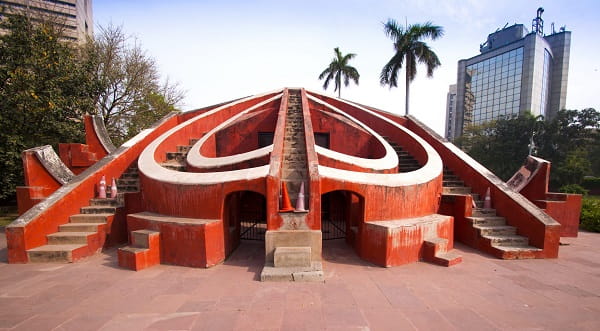
Built in 1724 as Jai Singh’s first major observatory, Delhi’s Jantar Mantar houses 13 architectural instruments, each with a specific astronomical function. Four are of particular note:
Samrat Yantra (Supreme Instrument) — The most striking structure: a massive right-angle triangle (gnomon) 27 metres long at 27 degrees incline — the latitude of Delhi — flanked by two quadrant arcs calibrated to measure local time. The shadow of the gnomon moves across the arcs, allowing accurate time-reading to within approximately 2 minutes. The scale of this sundial is both its scientific purpose and its architectural power — no photograph fully prepares visitors for its size.
Jai Prakash Yantra — Two concave hemispherical bowls set in the ground, calibrated with cross-wires and markings for celestial observation. By looking through the calibrated cross-wires at the sky from within the bowl, astronomers could determine the positions of celestial bodies relative to specific reference points.
Mishra Yantra (Mixed Instrument) — A compound instrument incorporating multiple astronomical functions in one structure: determining the longest and shortest days of the year, the exact time of noon at four world cities simultaneously, and the altitude of celestial bodies.
Ram Yantra — Two cylindrical structures with flat tops and vertical walls, both open to the sky. The structure itself is the measuring instrument — the shadow pattern of the central pole on the cylindrical walls at different times of day and year encodes astronomical information.
Historical Context: By the time the Delhi observatory was built in 1724, European astronomy was already advancing rapidly with telescopic instruments. Jai Singh was familiar with European methods — he reportedly received Euclid’s Elements and European astronomical tables as diplomatic gifts. He chose to build large-scale masonry instruments nonetheless, convinced that their greater physical size would yield greater precision than small brass devices. He was partly right: for naked-eye astronomy without telescopes, large instruments do achieve remarkable accuracy, and the Jaipur Samrat Yantra measures local time to within 2 seconds.
Current accuracy limitation: Delhi’s Jantar Mantar can no longer make accurate astronomical observations due to the tall buildings that now surround it — high-rises on multiple sides obstruct the horizon views needed for precise celestial measurement. The observatory functions today as a historical monument and architectural exhibit.
How to Reach Delhi Jantar Mantar
By Metro: The most convenient approach. Patel Chowk Metro Station (Yellow Line) is approximately 600 metres from the observatory — a 7 to 10-minute walk. The walk passes through the Parliament Street area.
By Road: Located on Sansad Marg (Parliament Street) in central New Delhi. Accessible by auto-rickshaw, cab, cycle-rickshaw, and DTC buses from anywhere in Delhi. Very close to Connaught Place.
Nearby: Connaught Place (500m), Parliament House (800m), India Gate (1.5 km), Rashtrapati Bhavan (1.5 km), Rajpath / Kartavya Path (1 km).
SECTION B: Jantar Mantar Jaipur — Ticket Price 2026
Entry Fee
| Category | Price |
| Indian Adults | ₹50 per person |
| Indian Students (with valid ID) | ₹15 – ₹20 per person |
| Foreign Nationals | ₹200 per person |
| Foreign Students (with ID) | ₹100 per person |
Note: Some sources cite ₹50 (Indian adult) and ₹200 (foreign); others cite slightly different figures. The figures above represent the most consistently reported 2026 rates. Verify at the ticket counter on arrival.
Combined ticket with City Palace: The Jaipur Jantar Mantar is located adjacent to the City Palace and a combined entry ticket covering multiple Jaipur heritage sites may be available. Check at the City Palace ticket counter for current composite ticket options.
Quick Overview — Jaipur Jantar Mantar
| Detail | Information |
| Location | Gangori Bazaar, J.D.A. Market, Pink City, Jaipur – 302002 |
| Status | UNESCO World Heritage Site (2010) |
| Protected By | Archaeological Sites and Monuments, Rajasthan (since 1961) |
| Built | 1728–1734 by Maharaja Sawai Jai Singh II |
| Completed | 1734 |
| Total Area | 18,000 sq metres |
| Number of Instruments | 19 |
| Open Days | All 7 days of the week |
| Timings | 9:00 AM – 4:30 PM to 7:00 PM (varies by source) |
| Indian Adult Entry | ₹50 |
| Foreign Adult Entry | ₹200 |
| UNESCO Recognition | 2010 |
Jaipur Jantar Mantar Timings
| Season | Timing |
| All year (standard) | 9:00 AM – 4:30 PM |
| Extended (summer/tourist season) | 9:00 AM – 7:00 PM |
Most sources cite 9:00 AM to 4:30 PM; some cite extended hours to 6:30 PM or 7:00 PM. Verify current closing time at the site or on the ASI website before planning an afternoon visit.
The 19 Instruments at Jaipur Jantar Mantar
Jaipur’s Jantar Mantar is not simply larger than the Delhi one — it is an order of magnitude more comprehensive, housing 19 architectural instruments compared to Delhi’s 13. It is the largest and most complete of the five Jantar Mantars in India.
Samrat Yantra (World’s Largest Sundial) — The iconic centrepiece and the most photographed structure. A right-angle triangle 27 metres tall with a 47-metre long hypotenuse, flanked by two massive quadrant arcs of marble. It measures local solar time with an accuracy of 2 seconds. Standing beside the gnomon — which is taller than a four-story building — and watching the shadow move visibly across the calibrated arcs during a midday visit is the defining sensory experience of the Jaipur observatory.
Jai Prakash Yantra — Two complementary concave marble hemispheres set in the ground with precisely calibrated markings. Each hemisphere contains a cross-wire suspended across the bowl and a circular scale around its rim. By observing celestial objects through the wire system, positions could be determined with high precision.
Mishra Yantra — The most complex instrument, serving multiple astronomical functions: determining the longest and shortest days of the year, the moment of noon at several world cities simultaneously (including London, Paris, and other then-significant cities), and the declination of celestial bodies.
Ram Yantra — Two large open cylindrical structures with graduated walls and floor markings, used for measuring the altitude and azimuth of celestial objects. The circular structures with open tops allow direct sky observation against the calibrated internal surfaces.
Laghu Samrat Yantra — A smaller version of the Samrat Yantra, calibrated specifically for Jaipur’s latitude.
Dakshinottara Bhitti Yantra (Meridian Wall) — A vertical north-south wall instrument used for measuring the meridian altitude and zenith distance of celestial bodies as they cross the meridian line. The instrument functions at the moment a star crosses due south.
Kapali Yantra — Similar in function to the Jai Prakash, with different calibration methodology.
Unnatamsha Yantra — A large circular ring mounted on a pillar, calibrated to measure the altitude of celestial objects.
Rashivalaya Yantra (12 Zodiac Instruments) — Twelve separate instruments in a unique arrangement, each calibrated for a specific zodiac sign. This zodiac-based instrument set allowed the determination of a celestial body’s ecliptic coordinates directly — without conversion calculations — at the moment it transited each zodiac band. No other observatory in the world has an equivalent instrument set.
These 12 instruments together constitute a unique astronomical tool that exists nowhere else on Earth, and they are central to Jaipur Jantar Mantar’s UNESCO designation.
Why UNESCO World Heritage Status?
The Jaipur Jantar Mantar was inscribed as a UNESCO World Heritage Site in 2010 under the criterion of outstanding universal value for:
- Being the finest and best-preserved example of a set of astronomical instruments from the early 18th century
- Representing the Rashivalaya’s unique contribution to astronomy — instruments that cannot be paralleled elsewhere
- Demonstrating the integration of scientific function with architectural form to a degree unmatched by contemporary European observatories
- Providing evidence of the cultural exchange between Indian, Islamic, and European astronomical traditions
Guided Tours at Jaipur Jantar Mantar
Authorised guides are available at the entrance. A guided tour lasting approximately 45 to 60 minutes significantly enhances the experience — many of the 19 instruments require explanation to appreciate their function. A basic observatory walk without guidance can be completed in 30 to 45 minutes but misses most of the scientific significance.
Guide fees are negotiable — approximately ₹200 to ₹400 for a 45-minute tour. Agree on fee and language before beginning.
The Other Three Jantar Mantars
For completeness — Maharaja Jai Singh II built five observatories. Beyond Delhi and Jaipur:
| Location | Status | Entry |
| Ujjain, Madhya Pradesh | Partially preserved; operational Vedic clock | Free or nominal |
| Varanasi, Uttar Pradesh | Located at Man Mandir Ghat; preserved instruments | Nominal fee |
| Mathura, Uttar Pradesh | Largely demolished; minimal remains | N/A |
The Ujjain Jantar Mantar (Vedhasala) is the second-best preserved after Jaipur and worth visiting for those in Madhya Pradesh.
Jaipur Jantar Mantar — How to Reach
By Road: Jaipur Jantar Mantar is located adjacent to the City Palace in the old walled city (Pink City), near Gangori Bazaar. From Jaipur Railway Station: approximately 3 km by auto-rickshaw (10 minutes). From Jaipur International Airport: approximately 13 km (30 to 40 minutes).
By Auto/Cab: Ola and Uber widely available. Set destination as “Jantar Mantar Jaipur” or the full address.
On Foot: Accessible from Hawa Mahal (500 metres), City Palace (200 metres), and Johari Bazaar (300 metres) — cluster these together for an efficient Pink City heritage tour.
Delhi vs Jaipur Jantar Mantar — Key Differences
| Factor | Delhi | Jaipur |
| Year Built | 1724 | 1728–1734 |
| Total Instruments | 13 | 19 |
| Area | Compact (central Delhi) | 18,000 sq metres |
| UNESCO Status | Not separately designated | Yes (2010) |
| Current Astronomical Accuracy | Limited (surrounding buildings) | Partially functional |
| Indian Entry Fee | ₹20–₹25 | ₹50 |
| Foreign Entry Fee | ₹250–₹300 | ₹200 |
| Visit Duration | 30–45 minutes | 45–90 minutes |
| Unique Feature | Convenient central location | World’s largest sundial; Rashivalaya 12 zodiac instruments |
For visitors choosing between the two: Jaipur’s observatory is more impressive, more complete, and more scientifically significant. Delhi’s is more conveniently located and fits naturally into a Connaught Place sightseeing day.
Best Time to Visit
Jaipur — October to March: The observatory is an outdoor site. Winter afternoons in Jaipur are mild and the low sun angle makes the Samrat Yantra’s shadow movements on the calibrated arcs more visually dramatic. Midday visits in summer work but require sun protection.
Delhi — Year-round: The compact site can be visited any time. Early mornings are pleasant and photographically excellent.
Midday for sundials: If you want to see the instruments functioning — the Samrat Yantra’s shadow actually moving across calibrated arcs — visit between 11:00 AM and 2:00 PM.
Visitor Tips
- At Jaipur: a guide is strongly recommended — the 19 instruments are scientifically opaque without explanation
- Allow 45 to 90 minutes at Jaipur, 30 to 45 minutes at Delhi
- Both sites are outdoors; carry sun protection, especially in summer
- Photography is free at both sites (video ₹25 at Delhi)
- Combine the Jaipur visit with the City Palace (adjacent), Hawa Mahal (500m), and Johari Bazaar
Frequently Asked Questions
Q1. What is the Jantar Mantar Delhi ticket price in 2026?
A: ₹20–₹25 for Indian citizens; ₹250–₹300 for foreign tourists. Children below 15 (Indian) enter free. Photography free; video filming ₹25.
Q2. What is the Jantar Mantar Jaipur ticket price in 2026?
A: ₹50 for Indian adults; ₹15–₹20 for Indian students with valid ID; ₹200 for foreign nationals; ₹100 for foreign students.
Q3. What are Jantar Mantar timings?
A: Delhi: Sunrise to sunset daily (approximately 6:00 AM–6:00 PM), open 7 days. Jaipur: 9:00 AM–4:30 PM (standard); extended to 7:00 PM during peak season. Open all 7 days.
Q4. Is Jantar Mantar Jaipur a UNESCO World Heritage Site?
A: Yes. The Jantar Mantar in Jaipur was inscribed as a UNESCO World Heritage Site in 2010, recognised as the finest example of 18th-century observatory architecture and for containing the unique Rashivalaya zodiac instruments found nowhere else in the world.
Q5. How long does a visit to Jantar Mantar take?
A: Delhi: 30 to 45 minutes. Jaipur: 45 to 90 minutes with a guide; 30 to 45 minutes without one. A guide is strongly recommended at Jaipur to understand the 19 instruments.