Patna has two museums and both are worth knowing before you visit. The Patna Museum — the original institution established in 1917 under British rule, locally known as Jadu Ghar (Magic House) — sits on Budh Marg in the older part of the city. The Bihar Museum — a globally acclaimed modern institution opened in 2015, designed by Japanese architects — stands on Bailey Road (Nehru Path) approximately 1.5 km away. Together they form the most comprehensive museum complex in Eastern India, and an under-construction tunnel will eventually connect them for seamless movement between the two.
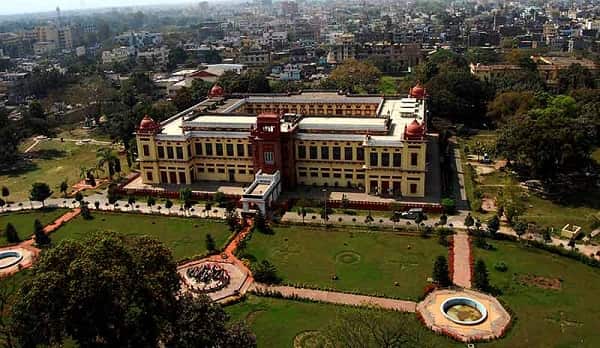
Patna Museum Ticket Price 2026 — Official Entry Fee
| Category | Entry Fee |
| Indian Nationals | ₹15 per person |
| Foreign Nationals | ₹250 per person |
| Children below 10 years | Free |
| School Students (with valid ID) | ₹5 per person |
Additional charges apply for photography equipment and licensed guides — verify the current rates at the museum counter on arrival. Smartphone photography is generally free.
Bihar Museum Ticket Price 2026 — Official Entry Fee
| Category | Entry Fee |
| Indian Nationals | ₹100 per person |
| Foreign Nationals | ₹500 per person |
| Children below 12 years | ₹50 per person |
Patna Museum — Quick Overview
| Detail | Information |
| Official Name | Patna Museum (Jadu Ghar / Magic House) |
| Address | Near Kotwali Thana, Budh Marg (Buddha Marg), Patna, Bihar – 800001 |
| Established | April 3, 1917 (opened to public 1929) |
| Architecture | Indo-Saracenic (Mughal and Rajput elements) |
| Indian Entry | ₹15 |
| Foreign Entry | ₹250 |
| Open Days | Tuesday to Sunday |
| Timings | 10:30 AM – 4:30 PM |
| Closed | Every Monday |
| Distance from Patna Junction | ~1 km (walkable or short rickshaw ride) |
| Distance from Airport | ~5 km |
| Star Exhibit | Didarganj Yakshi — Mauryan polished sandstone figure |
| Also Famous For | Holy Relic Casket (Buddha’s ashes); fossilised tree (200 million years old) |
Bihar Museum — Quick Overview
| Detail | Information |
| Official Name | Bihar Museum |
| Address | Nehru Path (Bailey Road), Near Gandhi Maidan, Patna, Bihar – 800004 |
| Website | biharmuseum.org |
| Inaugurated | 2015 |
| Architect | Maki and Associates, Japan |
| Area | 5.6 hectares; 24,000 sq metres built-up |
| Indian Entry | ₹100 |
| Foreign Entry | ₹500 |
| Open Days | Tuesday to Sunday |
| Timings | 10:00 AM – 5:00 PM |
| Closed | Monday + public holidays |
| Restaurant | Potbelly Restaurant (authentic Bihari cuisine — one of Patna’s best) |
| Distance from Patna Junction | ~3.2 km |
| Distance from Airport | ~4 km |
Timings 2026
Patna Museum
| Day | Opening | Closing |
| Tuesday to Sunday | 10:30 AM | 4:30 PM |
| Monday | Closed |
Bihar Museum
| Day | Opening | Closing |
| Tuesday to Sunday | 10:00 AM | 5:00 PM |
| Monday + public holidays | Closed |
History — The Patna Museum
Establishment Under British Rule
Patna Museum was founded on April 3, 1917, by Sir Edward Gait, the Lieutenant Governor of Bihar and Orissa. The immediate trigger was the recognition that Bihar’s extraordinary archaeological wealth — centred on Patna (ancient Pataliputra) and the surrounding Magadha heartland — needed institutional protection and organised display.
The museum was built in the Indo-Saracenic architectural style, combining European structural engineering with Mughal court decorative vocabulary — the dominant mode for British colonial public buildings in India of that era. The Patna version draws specifically from Mughal architecture, with arched openings, ornamental stone screens, and formal garden elements.
Opened to the public in 1929, twelve years after its establishment, it gained the popular name Jadu Ghar — Magic House — partly from the apparently inexplicable nature of its ancient objects (the fossilised tree, the relic casket, the polished stone sculptures) and partly from the building’s ornate grandeur relative to its surroundings.
The Didarganj Yakshi — The Collection’s Crown Jewel
The single most celebrated object in the Patna Museum’s collection is the Didarganj Yakshi — a life-size standing female figure in polished Chunar sandstone, discovered in 1917 near the Didarganj ghat on the banks of the Ganga.
The figure stands approximately 1.64 metres tall, depicted holding a fly-whisk (chowri), and is celebrated internationally for the extraordinary polish of its stone surface — achieving a mirror-like smoothness using only natural abrasives that has not been replicated in any subsequently dated Mauryan sculpture. The polish is so fine that the stone surface appears almost metallic under direct light.
In Hindu, Buddhist, and Jain traditions, a Yakshi is a female nature spirit associated with fertility, prosperity, and the abundance of the natural world. This example’s dating — variously placed in the 3rd century BCE (peak Mauryan period) to the 1st century BCE — connects it directly to the era when Pataliputra was the capital of the largest empire in South Asian history.
The Didarganj Yakshi is among the finest surviving examples of Mauryan art anywhere in the world. Its combination of naturalistic figural carving and technically demanding surface polish represents achievements in both artistry and craft that remain remarkable nearly 2,300 years later.
The Holy Relic Casket
Among the most theologically significant objects in the museum. The Holy Relic Casket is believed to contain the ashes (asthi dhatu) of Gautam Buddha, collected after his Mahaparinirvana at Kushinagar and distributed to multiple sites across the Gangetic plain.
The casket was discovered at Vaishali in Bihar during colonial-era excavations — inside a stupa, the characteristic Buddhist commemorative dome built over sacred relics. Vaishali’s significance in Buddhist history is profound: it was the city where the Buddha delivered his final sermon before his passing, and where the first Buddhist council was held.
For Buddhist pilgrims from Sri Lanka, Thailand, Japan, Myanmar, Cambodia, and China, the Patna Museum’s relic casket is a genuine pilgrimage destination rather than merely a heritage exhibit. The casket itself is an original Mauryan-era container; the relics it holds have been verified by both traditional scholarship and scientific analysis as consistent with the type of bone fragment relics distributed after the Buddha’s cremation.
The 200-Million-Year-Old Fossilised Tree
The Patna Museum’s natural history section houses a fossilised log dating to the Triassic period — approximately 200 million years old, contemporary with the earliest dinosaurs. This specimen predates the Himalayas by over 150 million years and reflects the geological complexity of the Indian subcontinent’s basement rocks.
Its presence in a museum known primarily for archaeological and art historical collections makes it genuinely surprising — one of the unexpected encounters that earned the building its Jadu Ghar nickname.
Other Notable Collections
Patna Kalam (Company Painting): The museum holds a collection of paintings from the British colonial period depicting everyday life in the Patna region. This genre — called Patna Kalam or Company School — developed when Mughal court artists adapted to working for East India Company patrons, producing botanical illustrations, bird studies, and genre scenes of Indian daily life in a hybrid style combining Mughal miniature traditions with European naturalistic conventions.
Rajendra Prasad Collection: Objects, documents, and memorabilia associated with Dr. Rajendra Prasad — India’s first President (1950–1962), a distinguished jurist and freedom movement leader from Bihar (born in Zeradei, Saran district).
Sculpture Collection: Mauryan, Sunga, Kushana, Gupta, and Pala dynasty sculptures spanning the 3rd century BCE to the 12th century CE — one of the most chronologically comprehensive sculpture collections in North India.
The Bihar Museum (2015) — The Modern Companion
Why a Second Museum Was Built
The Bihar Museum’s establishment was prompted by a practical problem and a philosophical ambition simultaneously. The practical problem: the 107-year-old Patna Museum was running out of space, with significant archaeological holdings in storage rather than on display. The philosophical ambition: to create an institution that could tell Bihar’s story through interactive, contemporary museum methodology rather than the static display conventions of the colonial-era building.
The Patna Museum and Bihar Museum are now co-managed under the same directorate (Director General, Bihar Museum) and host collaborative events, shared exhibitions, and educational programmes — screening International Museum Day films at both locations simultaneously, for example. The tunnel connecting them physically, when complete, will reinforce this integrated identity.
Architecture — Japanese Design in Patna
The Bihar Museum was designed by Maki and Associates, the internationally acclaimed Japanese architecture firm led by Fumihiko Maki (Pritzker Architecture Prize laureate, 1993). The design concept draws on the Japanese spatial philosophy of Oku — a sense of depth, layering, and progressive spatial discovery, where meaning reveals itself gradually rather than being presented all at once.
The result is a dispersed arrangement of low buildings integrated with the landscape rather than a single monolithic structure. Buildings are spaced across 5.6 hectares with terraces and courtyards connecting indoor and outdoor spaces — creating an experience of moving through a campus rather than a single building.
The exterior casing uses COR-TEN steel (weathering steel that develops a distinctive rust-coloured patina over time) — an unusual material choice for Indian museum architecture that gives the Bihar Museum a contemporary industrial gravitas deliberately contrasting with the Patna Museum’s colonial-era ornateness.
Galleries
Orientation Gallery: Short film overview of Bihar’s archaeological history and the methods archaeologists use to interpret the past. A useful 15-minute introduction for visitors without prior knowledge of the region.
History Gallery A: Prehistoric Bihar through to the Mauryan and Ashoka eras. Covers the emergence of Magadha as the dominant power in the Gangetic plain, the rise of Buddhism and Jainism (both born in Bihar and its adjacent territories), and the scale of Ashokan civilisation.
History Gallery B: Gupta Dynasty, Pala Dynasty, and the medieval period. The Gupta era — often described as India’s classical golden age — is particularly well represented with sculptures reflecting the refined aesthetic that influenced Buddhist art across all of Asia. The Visible Storage section here displays terracotta artefacts from Bihar and other Indian regions.
History Gallery C: Medieval Bihar through the Delhi Sultanate, Bengal Sultanate, Sur Dynasty, and British Accession. The Coin Storage section in this gallery holds coins from multiple historical periods — a particularly useful exhibit for understanding the economic and political transitions between eras.
Art Gallery: Contemporary and traditional art from Bihar, including works by Tikuli artists (800-year-old lacquerware painting tradition from Patna) and other regional art forms.
Children’s Gallery: Age-appropriate interactive exhibits designed to make Bihar’s history engaging for young visitors.
Potbelly Restaurant
Located within the Bihar Museum complex, Potbelly has become one of Patna’s most recommended restaurants independent of its museum context. The menu specialises in authentic Bihari cuisine — dishes rarely found in most Indian cities’ restaurant landscapes.
Must-try dishes at Potbelly:
- Litti Chokha — baked wheat balls (litti) with roasted eggplant and tomato mash (chokha). The quintessential Bihar street food at restaurant quality
- Sattu Paratha — flatbread stuffed with roasted chickpea flour filling
- Thekua — sweet deep-fried wheat and jaggery biscuit, a traditional Bihar festival food
- Champaran Meat — a slow-cooked mutton preparation from the Champaran district, different in character from both Lucknawi and Rajasthani meat preparations
The restaurant’s setting within the museum’s courtyard adds a quality to the dining experience that standard Patna restaurants cannot match.
How to Reach
Patna Museum (Budh Marg)
From Patna Junction Railway Station: Approximately 1 km — a 15-minute walk through the city centre or a 5-minute rickshaw/auto ride. The museum is directly on Budh Marg, one of Patna’s primary roads.
From Lok Nayak Jai Prakash Narayan Airport: Approximately 5 km — 15 to 20 minutes by cab.
Navigation: Set destination “Patna Museum Budh Marg” on Google Maps.
Bihar Museum (Nehru Path / Bailey Road)
From Patna Junction: Approximately 3.2 km — 10 to 15 minutes by cab or auto.
From Airport: Approximately 4 km — 15 to 20 minutes by cab.
Navigation: Set destination “Bihar Museum Patna Bailey Road.”
Combined Visit — Both Museums in One Day
With the Patna Museum opening at 10:30 AM and closing at 4:30 PM, and the Bihar Museum opening at 10:00 AM and closing at 5:00 PM, a combined visit in one day is feasible with planning:
Suggested schedule:
- 10:00 AM: Start at Bihar Museum (open 30 minutes earlier) — 2 to 2.5 hours for galleries
- 12:30 PM: Lunch at Potbelly Restaurant within the Bihar Museum
- 1:30 PM: Travel to Patna Museum (15 minutes by auto)
- 2:00 PM – 4:00 PM: Patna Museum — focus on Didarganj Yakshi, Relic Casket, Natural History section, and Patna Kalam paintings
Allow 2 to 3 hours for each museum for a thorough visit.
Best Time to Visit
October to February: Patna’s winter (8°C to 25°C) is the most comfortable season for extended museum visiting. The Bihar Museum’s outdoor courtyards and terraces are most enjoyable in cool weather. Both museums are at their least crowded in January–February outside of school holiday periods.
Weekday mornings: Both museums see peak footfall from school groups between 10:30 AM and 12:30 PM on weekdays during the academic year. Arriving at opening time or after 1:00 PM reduces the school group overlap.
Avoid: May and June — Patna’s summer is extreme (often exceeding 42°C) and while both museums are air-conditioned inside, the walk between sections at the Bihar Museum and the travel between the two institutions becomes physically demanding.
Frequently Asked Questions
Q1. What is the Patna Museum ticket price in 2026?
A: ₹15 for Indian nationals; ₹250 for foreign nationals. Children below 10: free. School students with ID: ₹5. Open Tuesday to Sunday, 10:30 AM to 4:30 PM. Closed every Monday.
Q2. What is the Bihar Museum ticket price in 2026?
A: ₹100 for Indian nationals; ₹500 for foreign nationals. Children below 12: ₹50. Open Tuesday to Sunday, 10:00 AM to 5:00 PM. Closed Mondays and public holidays.
Q3. What is the Didarganj Yakshi?
A: A life-size Mauryan-era polished Chunar sandstone female figure discovered at Didarganj ghat, Patna, in 1917. One of the finest surviving examples of Mauryan sculpture — celebrated for its extraordinary mirror-like stone polish. Dated to approximately 3rd–1st century BCE.
Q4. Are the Patna Museum and Bihar Museum the same institution?
A: No. The Patna Museum (1917) is the original colonial-era institution on Budh Marg. The Bihar Museum (2015) is a modern institution on Bailey Road designed by Japanese architects. Both are separate, both require their own tickets, and both are co-managed under the same directorate. An under-construction tunnel will eventually connect them physically.
Q5. What should I eat at the Bihar Museum?
A: The Potbelly Restaurant inside the Bihar Museum complex is one of Patna’s most recommended dining spots for authentic Bihari cuisine — particularly Litti Chokha, Sattu Paratha, and Champaran Meat. Worth visiting as a standalone dining destination even without the museum visit.