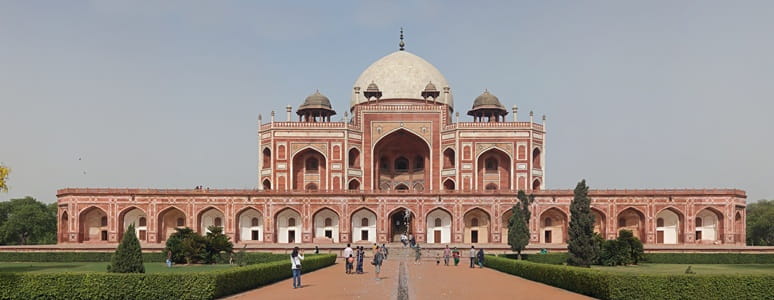
There is a moment, walking through the arched gateway of Humayun’s Tomb into the Char Bagh garden, when the full symmetry of the structure reveals itself — the red sandstone facade, the white marble double dome, the formal water channels dividing the garden into quadrants — and it becomes immediately obvious why the architects who designed the Taj Mahal studied this building. Completed in 1572 by Bega Begum, the senior widow of Mughal Emperor Humayun, this tomb complex on Mathura Road in Nizamuddin was the first true garden tomb built in India, the first structure to fully express the Mughal architectural vocabulary that would culminate 90 years later at Agra.
It is a UNESCO World Heritage Site since 1993. It remains one of Delhi’s most rewarding heritage visits. At ₹40 for Indian visitors, it is also exceptional value.
Humayun’s Tomb Ticket Price 2026 — Official Entry Fee
| Category | Entry Fee |
| Indian Citizens / SAARC & BIMSTEC Nationals | ₹40 per person |
| Foreign Nationals | ₹600 per person |
| Children below 15 years (Indian) | Free |
| Students (Indian, with valid ID) | ₹15 per person |
Photography: Free for smartphones and personal cameras. No additional charge.
Video filming: Permitted; a nominal charge may apply for professional equipment.
Note on pricing: ASI periodically revises entry fees. Multiple sources from July 2025 confirm ₹40 (Indian) / ₹600 (foreign). Some older sources cite ₹30–₹35 / ₹250–₹300 — these reflect previous rates. Always verify current pricing at asi.payumoney.com before booking.
Humayun’s Tomb — Quick Overview
| Detail | Information |
| Official Name | Maqbara-e-Humayun (Humayun’s Tomb) |
| Location | Mathura Road, Opposite Dargah Nizamuddin, Nizamuddin East, New Delhi – 110013 |
| Protected By | Archaeological Survey of India (ASI) |
| UNESCO Status | World Heritage Site (1993) |
| Built | 1565–1572 AD |
| Commissioned By | Bega Begum (Haji Begum), senior wife of Humayun |
| Architect | Mirak Mirza Ghiyas (Persian); completed by son Sayyid Muhammad ibn Mirak |
| Open Days | All 7 days (no weekly holiday) |
| Timings | 6:00 AM – 6:00 PM |
| Online Booking | asi.payumoney.com |
| Nearest Metro | Jawaharlal Nehru Stadium (Violet Line) ~2 km |
| Also Near | Hazrat Nizamuddin Railway Station (~1 km) |
| Indian Entry Fee | ₹40 per person |
| Foreign Entry Fee | ₹600 per person |
| Children below 15 | Free (Indian citizens) |
Timings 2026
| Days | Timing |
| All 7 days of the week | 6:00 AM – 6:00 PM |
Humayun’s Tomb has no weekly holiday and is open throughout the year including national holidays. Ticket counters typically close 15 to 20 minutes before the official 6:00 PM closing — enter by 5:30 PM to avoid being denied entry.
History and Architecture
The Story Behind the Tomb
Humayun was the second Mughal emperor, son of Babur and father of Akbar. His reign (1530–1540 and 1555–1556) was marked as much by adversity as achievement — he was driven out of India by the Afghan Suri dynasty in 1540, spent fifteen years as an emperor in exile in Persia, and recaptured Delhi in 1555, only to die the following year from injuries sustained falling down the steps of his library. He ruled for barely a year after reclaiming his empire.
His widow, Bega Begum (also known as Haji Begum), had accompanied him during the Persian exile and absorbed the architectural influences of the Safavid court. In 1565, nine years after Humayun’s death, she commissioned his tomb using a Persian architect, Mirak Mirza Ghiyas, who died before completion. His son Sayyid Muhammad ibn Mirak completed the work. The total cost was reportedly ₹1.5 million rupees of the era — an enormous sum funded by Bega Begum’s own wealth.
Architectural Significance
First garden tomb in India: The Char Bagh (four-garden) layout surrounding the tomb — a formal Persian garden divided by water channels into quadrants — was new to India in 1572. Every subsequent major Mughal tomb, including the Taj Mahal, adopted this format.
First Mughal-style structure in India: The complete vocabulary of Mughal architecture — red sandstone primary structure with white marble accents, high arched iwans (vaulted portals), double dome, octagonal plan, elevated platform — appeared fully formed here for the first time in India.
Double dome: The hollow space between the inner and outer domes creates the visual height of the exterior while maintaining proportional interior ceiling height. This structural innovation, derived from Persian and Central Asian traditions, was used in every significant Mughal structure thereafter.
Dimensions: The tomb stands 47 metres tall and 91 metres wide. The outer dome reaches 42.5 metres. The entire structure rests on a 7-metre-high raised platform, which contains additional burial chambers and structural spaces.
Materials: Red Bharatpur sandstone (from Rajasthan) for the primary structure; white Makrana marble (from Rajasthan) for the dome, decorative inlay, and accents — the same material combination used for the Taj Mahal.
What to See at Humayun’s Tomb Complex
The Main Tomb (Maqbara-e-Humayun)
The central structure containing Humayun’s cenotaph (symbolic sarcophagus) on the main floor, with the actual grave in the chamber below. The interior of the main chamber is austere by Mughal standards — the focus is entirely on the architectural proportions and the quality of light through the lattice screens (jalis). Standing in the central octagonal hall and looking up at the inner dome is the defining visual moment of the complex.
The 150 tombs: The entire complex contains approximately 150 graves, making it the largest concentration of Mughal burials in a single complex in India. The main mausoleum alone holds the remains of more than 100 members of the Mughal royal family.
Isa Khan’s Tomb
Located just inside the main entrance gate, separate from the central complex — the octagonal tomb of Isa Khan Niazi, an Afghan nobleman and commander under Sher Shah Suri (the same ruler who exiled Humayun). Built in 1547, it predates Humayun’s Tomb and is notable for its lower, ground-level pavilion form — a contrasting architectural style that makes it an effective introduction to the evolution of tomb design visible within the complex.
Bu Halima’s Garden and Gateway
The first gateway approaching the complex, through Bu Halima’s Garden — a smaller enclosed garden space that serves as a transitional zone between the busy Mathura Road and the formal Char Bagh interior.
Arab Serai (Caravanserai)
A large walled enclosure adjacent to the main complex, built to house the 300 Persian craftsmen brought from Iran by Bega Begum to build the tomb. The gateway of the Arab Serai is one of the earliest surviving gateways in Delhi.
Afsarwala’s Tomb and Mosque
A secondary tomb and mosque within the complex grounds, mid-16th century, part of the ensemble of Mughal structures that accumulated around the central mausoleum.
Nila Gumbad (Blue Dome)
Located just outside the main complex perimeter on the Mathura Road side — a striking 16th-century tomb with a blue-tiled dome, one of the earliest examples of coloured tile work in Delhi. Currently (2026) being restored.
Sundarwala Burj and Lakkarwala Burj
Two octagonal towers within the complex grounds, both part of the 16th-17th century accretion of Mughal structures in the Nizamuddin area.
Notable Burials in the Complex
| Person | Relationship |
| Emperor Humayun | Second Mughal Emperor |
| Bega Begum (Haji Begum) | Chief consort; commissioned the tomb |
| Hamida Banu Begum | Mother of Emperor Akbar |
| Dara Shikoh | Eldest son of Shah Jahan; executed by Aurangzeb |
| Emperor Jahandar Shah | Mughal Emperor (1712–13) |
| Emperor Farrukhsiyar | Mughal Emperor (1713–19) |
| Rafi ud-Darjat | Mughal Emperor (1719) |
| Rafi ud-Daulat | Mughal Emperor (1719) |
| Muhammad Kam Bakhsh | Youngest son of Aurangzeb |
Last Mughal Connection: In 1857, following the Uprising, British Lieutenant W.S.R. Hudson captured the last Mughal Emperor Bahadur Shah Zafar II here, sheltering in the complex with his sons.
How to Book Tickets Online
Official ASI Portal: asi.payumoney.com — select city (Delhi), monument (Humayun’s Tomb), choose date and number of visitors, enter passenger details, and pay online. A QR code e-ticket is issued immediately.
Advantages of online booking: Avoids counter queues, particularly on weekends; provides a small discount over walk-in rates in some periods; tickets issued instantly.
Important: Some counter staff experience connectivity issues for QR scanning — carry both digital and printed copies of the ticket.
Caution: Only book through asi.payumoney.com or authorised ASI platforms. Unofficial websites claim to sell tickets but are not legitimate — always verify the URL.
How to Reach Humayun’s Tomb
By Metro:
- Jawaharlal Nehru Stadium (Violet Line) — Nearest station, approximately 2 km from the tomb. Take an auto-rickshaw or e-rickshaw from the exit (5 to 10 minutes, ₹30 to ₹50).
- Jor Bagh (Yellow Line) — Approximately 5 km; longer option.
- Hazrat Nizamuddin (Pink Line, Kashmere Gate–Raja Nahar Singh) — Check current extension status; may be closer when operational.
By Railway: Hazrat Nizamuddin Railway Station is approximately 1 km from the complex — the most direct approach if arriving by intercity train. Auto-rickshaws and e-rickshaws are available immediately outside the station.
By Road: Located on Mathura Road directly opposite Dargah Hazrat Nizamuddin. Accessible by Ola, Uber, DTC buses (multiple routes serve Nizamuddin), and autos from anywhere in Delhi.
Parking: Limited paid parking available near the Sabz Burj (blue-domed structure at the entrance circle). In peak tourist season and weekends, parking fills quickly — metro or cab approach is recommended.
Nearby Attractions
Humayun’s Tomb’s Nizamuddin location clusters it naturally with:
- Dargah Hazrat Nizamuddin Auliya — Directly opposite the main entrance; the 14th-century shrine of Sufi saint Nizamuddin Auliya; qawwali (Sufi devotional music) performed every Thursday evening
- Amir Khusrau’s Tomb — Within the Nizamuddin dargah complex; burial site of the 13th-century poet-musician and disciple of Nizamuddin
- Sunder Nursery — Adjacent to the Humayun’s Tomb complex; a beautifully landscaped heritage park with 16th-century Mughal monuments amid cultivated gardens
- Lodi Garden — 2 km; 15th-century Sayyid and Lodi dynasty tombs in a public park setting
Best Time to Visit
October to February: Delhi’s winter is the ideal window. Pleasant temperatures (10°C to 25°C), blue skies, and low humidity make the outdoor complex — the garden, the elevated platform walkways, the approach pathways — genuinely comfortable. The red sandstone in winter morning light is particularly photogenic.
Golden hour (morning): Arrive at 6:00 AM opening for best photography light and minimal crowd. The east-facing main gateway catches the morning sun; the tomb’s red sandstone glows warm against the early blue sky.
Avoid midday (April to June): Delhi summer temperatures regularly exceed 42°C. The complex has minimal shade. If visiting in summer, arrive before 9:00 AM or after 4:00 PM.
Visitor Tips
- Arrive 15 minutes before opening (6:00 AM) on weekends for the best photography conditions with zero crowds
- Carry a valid photo ID — checked at entry for all adult visitors
- Allow 1.5 to 2 hours for a thorough visit of the entire complex including Isa Khan’s Tomb
- Photography is free; the best shots are from the raised platform corners looking across the Char Bagh garden toward the main dome
- Combine with Sunder Nursery (entrance adjacent) and Nizamuddin Dargah (across the road) for a full half-day heritage circuit
- Guides are available at the main gate; typical fee ₹200 to ₹500 for an hour tour
Frequently Asked Questions
Q1. What is Humayun’s Tomb entry fee in 2026?
₹40 per person for Indian citizens and SAARC/BIMSTEC nationals. ₹600 per person for foreign tourists. Children below 15 years (Indian) enter free. Students with valid ID pay ₹15.
Q2. What are Humayun’s Tomb timings?
Open daily from 6:00 AM to 6:00 PM, including weekends and national holidays. No weekly holiday.
Q3. How do I book Humayun’s Tomb tickets online?
Book at asi.payumoney.com — select Delhi, Humayun’s Tomb, date, visitor details, and pay online. A QR code e-ticket is sent immediately. Only use the official ASI portal.
Q4. Which metro station is nearest to Humayun’s Tomb?
Jawaharlal Nehru Stadium on the Violet Line is the closest, approximately 2 km away. Auto-rickshaws and e-rickshaws are available at the station exit.
Q5. Why is Humayun’s Tomb significant?
It is the first garden tomb and first fully Mughal-style structure built in India, serving as the direct architectural prototype for the Taj Mahal. It is also a UNESCO World Heritage Site (1993) and houses approximately 150 graves of Mughal royals.