In the middle of Lucknow’s Hazratganj — one of the most historic commercial and civic zones in North India — behind the gates of the Nawab Wajid Ali Shah Prani Udyan, 71.6 acres of the city belong to its animals. The zoo’s formal name honours Wajid Ali Shah, the last Nawab of Awadh, whose reign ended with the British annexation of Oudh in 1856 — and the campus itself occupies what was originally an 18th-century mango orchard planted by Nawab Nasiruddin Haider, known to Lucknow’s older residents simply as Banarasi Bagh. Whatever you call it, this is one of North India’s oldest (established 1921) and most visited urban zoos, attracting more than a million visitors annually.
Lucknow Zoo Ticket Price 2026 — Official Entry Fee (Revised from 1 October 2025)
The official Lucknow Zoo website (lucknowzoo.com) confirmed revised ticket prices effective 1 October 2025:
| Category | New Rate (from 01.10.2025) |
| Adults (above 12 years) | ₹100 per person |
| Children (5–12 years) | ₹50 per person |
| Children below 5 years | Free |
Important: All visitors are now issued a colour wristband at the ticket counter alongside their ticket. Entry to the zoo is not permitted without the wristband. E-ticket holders must exchange their e-ticket at the ticket counter for the wristband before proceeding to the gate.
Additional / Package Charges
Older UP Tourism sources listed a package structure covering entry + specific attractions. With the October 2025 revision, the following is the most current confirmed structure — verify exact add-on pricing at the zoo counter or lucknowzoo.com as some services may have been restructured:
| Package | Approximate Price (Adults) |
| Entry only (standard) | ₹100 |
| Entry + Aquarium + Nocturnal House + Nature Interpretation Centre | ~₹60–₹100 (may now be included in base ticket — verify) |
| Package with Bal Train (Toy Train) included | ~₹80–₹100 (children); ₹100+ adults |
Note: Some older sources cite ₹60 (adult basic) and ₹30 (child basic) — these reflect pre-October 2025 rates. As of 01.10.2025, the revised rates are adults ₹100 and children ₹50. Verify the current add-on structure at the ticket window.
Photography
| Equipment | Charge |
| Smartphone | Free |
| Still Camera | Nominal charge (verify at counter) |
| Video Camera | ₹50 (older rate) |
Morning Walk Pass (For Regular Visitors)
| Pass Type | Cost |
| Monthly Pass | ₹100 |
| Yearly Pass | ₹500 |
Lucknow Zoo — Quick Overview
| Detail | Information |
| Official Name | Nawab Wajid Ali Shah Prani Udyan |
| Common Names | Lucknow Zoo / Banarasi Bagh / Prince of Wales Zoological Gardens (historic) |
| Address | Hazratganj Road, Opp. to Civil Hospital, Hazratganj, Lucknow, UP – 226001 |
| Phone | +91-8005493617 |
| Website | lucknowzoo.com |
| Booking | lucknowzoo.com/booking.html |
| Established | 1921 |
| Area | 71.6 acres (29 hectares) |
| Animal Count | 1,000+ animals, birds, reptiles across 97 species |
| Open Days | Tuesday to Sunday (Closed Monday + Holi) |
| Adult Entry | ₹100 (from 01.10.2025) |
| Child Entry (5–12 yrs) | ₹50 (from 01.10.2025) |
| Children below 5 | Free |
| Distance from Lucknow Junction | ~4 km |
| Nearest Metro | Hazratganj (~20-minute walk) |
Lucknow Zoo Timings 2026
| Month | Opening | Closing |
| February to April | 8:30 AM | 5:30 PM |
| May to July | 8:00 AM | 6:00 PM |
| August to October | 8:30 AM | 5:30 PM |
| November to January | 8:30 AM | 5:00 PM |
| Closed | Every Monday + Holi Festival Day |
Last entry: 30 minutes before official closing time.
Morning Walk: Available during specific early morning hours (before general visitor opening) — check lucknowzoo.com for current morning walk timings.
History of Lucknow Zoo
From Mango Orchard to Royal Zoo
The land was originally developed as a private mango orchard by Nawab Nasiruddin Haider (Nawab of Awadh, 1827–1837) — an enclosed garden space known as Banarasi Bagh, supposedly named for mango saplings imported from Banaras. The Nawabs of Awadh maintained extensive private menageries and natural gardens, and the Banarasi Bagh was part of this tradition of royal landscaping.
The Colonial Zoo (1921)
The formal zoological garden was established in 1921 — the occasion being the visit of the Prince of Wales (the future King Edward VIII) to Lucknow. Sir Harcourt Butler, then Governor of United Provinces, conceived the zoo as a permanent civic institution. Prominent landowners and citizens donated animals and funds; 26 structures and cages were built at a total cost of ₹2,08,800 between 1921 and 1926. The main gate — Sir Ludovic Porter Gate on the Narahi side — was added in 1936.
1926: The Managing Committee was formally registered under the Societies Registration Act.
1950: The Managing Committee was dissolved after Indian independence; an Advisory Committee took over management under the UP state government.
2001: Name changed from Prince of Wales Zoological Gardens Trust to Lucknow Prani Udyan.
2015: Renamed again to Nawab Wajid Ali Shah Prani Udyan in honour of the last Nawab of Awadh.
Unique Heritage
Lucknow Zoo is one of only two zoos in India housing orangutans — the great apes native to Borneo and Sumatra, now critically endangered in the wild. This distinction is historically significant and continues to draw wildlife enthusiasts who may not otherwise include Lucknow in a zoo tourism itinerary.
Animals and Wildlife
Across 71.6 acres and 97 documented species, the zoo’s collection spans:
Carnivores (Big Cats and Predators)
Royal Bengal Tiger — Two male and two female tigers, individually named. The Bengal Tiger enclosures are among the zoo’s most visited; the animals are typically visible in the morning and late afternoon when temperatures encourage movement. The white tiger (leucistic Bengal tiger) is also present — a colour morph with significant historical association with Awadh (the Maharaja of Rewa maintained a white tiger breeding line in the mid-20th century, from which most captive white tigers worldwide descend).
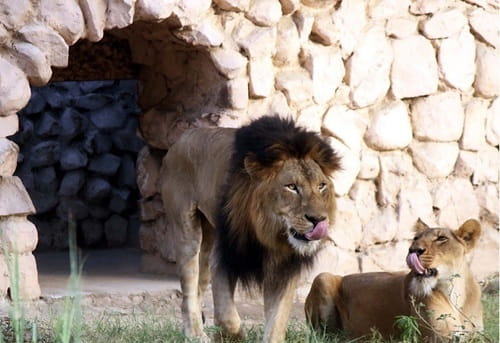
Asiatic Lion — One male (Vishal) and one female (Kajal). The Asiatic lion is Gujarat’s most significant large predator and among India’s most endangered mammals — the wild population is entirely restricted to the Gir Forest. Lucknow Zoo’s pair contributes to the captive gene pool.
Leopard / Panther — Both spotted and black varieties present at various times.
Indian Wolf — One of the more unusual predator exhibits in the zoo; the Indian wolf is a distinct subspecies increasingly rare in the wild.
Striped Hyena — A commonly overlooked but ecologically important scavenger; Lucknow’s hyena enclosure is well-maintained.
Jackal and Fox — Small-predator exhibits with species native to the Gangetic plains.
Herbivores
Giraffe — The most visually striking animal at the zoo; the Lucknow Zoo giraffe enclosure provides reasonable space for natural movement.
Indian Rhinoceros — The greater one-horned rhinoceros from the Brahmaputra plains, now primarily surviving in Kaziranga and Chitwan. One of the zoo’s conservation success stories.
Hippopotamus — Rarely exhibited in Indian zoos; Lucknow is one of the few zoos in North India with hippopotamus on display.
Zebra — African origin; part of the zoo’s large herbivore section.
Indian Bison (Gaur) — The world’s largest bovine, native to the Indian subcontinent’s forests.
Swamp Deer (Barasingha) — UP’s state animal; critically endangered in the wild with its most significant population in Dudhwa National Park, which is also in Uttar Pradesh. The zoo maintains a breeding pair.
Chinkara, Blackbuck, Spotted Deer (Chital), Nilgai — Multiple Indian antelope and deer species in naturalistic enclosures.
Primates
Orangutan — The zoo’s most globally significant exhibit. One of only two Indian zoos housing this species. The Bornean/Sumatran orangutans are among the most intelligent and behaviourally complex animals in the zoo.
Hoolock Gibbon — India’s only ape (not monkey) native to the subcontinent; arboreal and highly active.
Stump-Tailed Macaque — A large, distinctive macaque species from Northeast India.
Assamese Macaque, Rhesus Macaque, Langur — Multiple monkey species representing North and Northeast Indian wildlife.
Birds
Great Pied Hornbill — An instantly recognisable and large forest bird with a distinctive casque above its bill; an iconic species of the Eastern Himalayan forests.
Golden Pheasant, Silver Pheasant, Kalij Pheasant — Three pheasant species in the aviary section; all are colourful and rewarding for birdwatchers.
White Peacock — A rare colour morph of the Indian Peafowl (India’s national bird); unusual enough to be a reliable visitor draw.
Indian Griffon Vulture — Part of the zoo’s raptor section; large and impressive at close proximity.
Demoiselle Crane, Spoonbill, Stork species — Waterbird exhibits.
Hill Myna — Famous for vocal mimicry; the zoo’s hill myna enclosure is a surprisingly entertaining stop for visitors.
Reptiles
Marsh Mugger Crocodile — The most widespread Indian crocodile, present in the zoo’s reptile pond.
Ghariyal (Gharial) — The critically endangered fish-eating crocodilian native to the Gangetic system; one of India’s most endangered reptiles. Lucknow Zoo’s gharial pool is a conservation-significant exhibit.
Indian Python, Rock Python — Large constrictors in the reptile house.
Indian Cobra — The most iconic Indian venomous snake, maintained safely in the reptile enclosure.
Indian Monitor Lizard (Bengal Monitor) — India’s largest lizard species.
Attractions Beyond the Animals
Bal Train (Toy Train) — 1.5 km Circuit
A miniature toy train ride that circuits through the zoo’s main sections — an efficient way for families with young children to cover the 71.6-acre campus without excessive walking. The train runs on a 1.5 km track with an engine and multiple coaches. It is historically significant as an exhibit in its own right — a vintage train originally found decommissioned in the Laxmipur forest that was restored and brought into service at the zoo. Separate charge applies (included in package tickets).
Aquarium House
A dedicated aquarium housing freshwater and exotic fish species including the Albino Tiger Shark, Albino Walking Catfish, Albino Red Tail, and Alligator Gar — species that provide a distinctly different educational experience from the terrestrial animal enclosures.
Nocturnal Animal House
A low-light exhibit where nocturnal animals (owls, small cats, lorises) are maintained in inverted day/night cycles and observed in simulated nighttime conditions. Similar to Hyderabad’s pioneering nocturnal house, Lucknow’s version allows visitors to observe normally-nocturnal species when they are naturally active.
Butterfly Park (Opened 2018)
A dedicated butterfly garden with 28 documented butterfly species alongside information displays. The garden’s vegetation is curated to attract and retain butterfly species native to the Lucknow region. A relatively recent addition that has become particularly popular with school groups.
Nature Interpretation Centre
A mini-museum and educational exhibit with animal artefacts — preserved skins of lions, tigers, deer, pandas, and snakes; bird eggs including ostrich, emu, and macaw; tiger pugmark casts; elephant tusks; and biological specimens. The “Touch Table Programme” runs on Fridays — a hands-on session where visitors can physically handle preserved specimens under staff guidance.
State Museum (Uttar Pradesh State Museum)
Located within the zoo campus, the UP State Museum was relocated from Chattar Manzil to its current location in 1963. It houses:
- Awadhi sculpture and bronzes
- Miniature paintings
- Natural history specimens
- Coins spanning multiple historical periods
- Textile and decorative arts from the Mughal and Nawabi eras
- An Egyptian mummy with its original wooden sarcophagus
- A wine jar bearing the inscription of Aurangzeb Alamgir
- A 16th-century painting from the Kalpasutra (Jain manuscript)
- A jade Chamakali piece dated to the Jahangir period
The Egyptian mummy alone makes the museum notable — genuinely unexpected in a North Indian city zoo complex. The museum visit is essentially free as part of the zoo campus entry.
Paddle Boating
A paddle boating facility on the zoo’s water body. Seasonal and available on specific days — confirm at the zoo.
How to Reach Lucknow Zoo
Address: Hazratganj Road, Opposite Civil Hospital, Hazratganj, Lucknow, UP – 226001.
By Metro: Hazratganj is the nearest Lucknow Metro station — approximately 20 minutes’ walk from the zoo. Alternatively, take an auto-rickshaw from the metro exit (5 minutes, ₹30 to ₹50).
By Road: The zoo is centrally located in Hazratganj, 4 km from Lucknow Junction (railway station) and 1 km from the city centre. Auto-rickshaws, cycle rickshaws, and shared autos are available throughout Hazratganj. Cab fare from the railway station: approximately ₹80–₹120.
By Bus: Multiple city bus routes serve Hazratganj / Civil Hospital area.
By Air: Chaudhary Charan Singh International Airport is approximately 14 km from the zoo. Cab to zoo: ₹350–₹600 depending on traffic.
Parking: Limited parking near the zoo entrance on Hazratganj Road. Two-wheelers and smaller vehicles can be accommodated; larger vehicles may need to park further away.
Online Booking
Book tickets online at lucknowzoo.com/booking.html. E-ticket holders must collect a colour wristband at the ticket counter before entering. The zoo now uses the wristband system for entry management — without the wristband, entry is not permitted even with a valid e-ticket.
Best Time to Visit
October to February: The ideal season. Lucknow’s winter (10°C to 25°C) keeps the zoo campus comfortable for walking and animals are visibly more active during the cooler daytime hours. Tiger, lion, and bear enclosures see maximum animal movement in this period.
Morning opening (8:00–8:30 AM): The best window for animal viewing — feeding time for many species; most active behaviour window; quietest hour before school groups arrive.
February to April: Pleasant temperatures and the butterfly park is at its most vibrant. A good season for photography.
Avoid: Peak summer midday (May to June). Most large animals retreat indoors in heat above 38°C and the campus walk becomes uncomfortable.
Frequently Asked Questions
Q1. What is the Lucknow Zoo ticket price in 2026?
₹100 for adults (above 12 years); ₹50 for children (5–12 years); free for children below 5 years. These are revised rates effective 1 October 2025, confirmed on the official lucknowzoo.com website.
Q2. What are Lucknow Zoo timings?
Tuesday to Sunday (closed Monday and Holi): Feb–Apr 8:30 AM–5:30 PM; May–Jul 8:00 AM–6:00 PM; Aug–Oct 8:30 AM–5:30 PM; Nov–Jan 8:30 AM–5:00 PM. Last entry 30 minutes before closing.
Q3. Is the Lucknow Zoo open on Mondays?
No. The zoo observes a weekly closure every Monday, plus the day of Holi festival.
Q4. What is unique about Lucknow Zoo?
It is one of only two zoos in India housing orangutans (critically endangered great apes). It also contains the UP State Museum — including an Egyptian mummy, a remarkable collection of Awadhi artefacts, and Mughal-era objects — within the zoo campus.
Q5. How do I book Lucknow Zoo tickets online?
At lucknowzoo.com/booking.html. E-ticket holders must collect a colour wristband at the ticket counter before entry — entry is not allowed without the wristband even with a confirmed e-ticket.