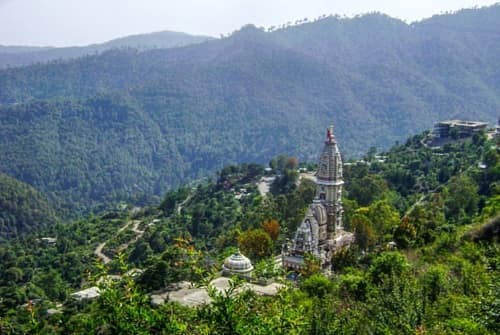
Six kilometres from Solan city in Himachal Pradesh, on a hilltop surrounded by the pine-covered ridges of the lower Shivalik range, rises a structure that looks like it arrived from Tamil Nadu — a soaring South Dravidian gopuram-style tower of three ascending pyramids, each tier intricately carved, crowned with Lord Shiva’s trishul, reaching approximately 111 to 122 feet into the Himachali sky. Jatoli Shiv Mandir is widely described as Asia’s tallest Shiva temple, and the contrast between its distinctly South Indian architectural style and its North Indian Himalayan setting is the first striking thing about it. The second is that entry is completely free.
Jatoli Shiv Mandir Ticket Price 2026
Entry Fee: FREE
Jatoli Shiv Mandir charges no entry fee. Darshan, temple visits, circumambulation of the complex, access to the Jal Kund (sacred water tank), and the cave where Swami Krishnananda meditated — all are free of charge to all visitors regardless of religion or origin.
There are no camera fees, no photography charges (though photography inside the sanctum is restricted), and no service charges.
| Category | Entry Fee |
| All visitors (Indian and foreign) | Free |
| Camera/photography | Free (restricted inside main sanctum) |
| Parking | Nominal or free |
Donations: A donation box is available for those who wish to contribute to temple maintenance. This is entirely voluntary.
Jatoli Shiv Mandir — Quick Overview
| Detail | Information |
| Full Name | Jatoli Shiv Mandir (Jatoli Mahadev Temple) |
| Location | Jatoli Village, Solan District, Himachal Pradesh – 173212 |
| Distance from Solan | ~6–8 km |
| Height of Temple | ~111–122 feet (approximately 34–37 metres) |
| Claim | Asia’s tallest Shiva temple |
| Architectural Style | South Indian Dravidian (Gopuram) |
| Construction Period | 39 years (approximately 1974–2013) |
| Founded By | Swami Krishnananda Paramhansa Ji |
| Entry Fee | FREE |
| Timings | 6:00 AM – 8:00 PM (daily) |
| Weekly Holiday | None — open every day |
| Photography | Permitted in complex; restricted inside sanctum |
| Nearest Town | Solan (6–8 km) |
| Nearest Airport | Chandigarh International Airport (~55 km) |
| Nearest Railway Station | Solan Railway Station (Kalka–Shimla toy train line) ~6–8 km |
Jatoli Shiv Mandir Timings 2026
| Day | Timing |
| All 7 days (including holidays) | 6:00 AM – 8:00 PM |
The temple is open every day of the year without exception. Timings may extend during major festivals, particularly Mahashivratri, when the temple observes all-night worship.
Aarti timings:
- Morning Aarti: 7:00 AM – 7:30 AM
- Evening Aarti: 7:00 PM – 7:30 PM
History and Legend
The Founding Sage
The modern Jatoli Shiv Temple owes its existence to Swami Krishnananda Paramhansa Ji, a revered ascetic who arrived at this hilltop in the mid-20th century and chose it as his place of meditation. According to temple tradition, the Jatoli site carries ancient significance — an ancient Shiva Lingam was already present here, believed to have been in place since time immemorial, predating even the temple’s formal construction.
The construction of the towering gopuram structure began in approximately 1974 and took 39 years to complete, being formally consecrated around 2013. The entire construction was built over this extended period through the devotion and donations of pilgrims and supporters of the temple.
Swami Krishnananda Paramhansa Ji reportedly meditated in the cave within the temple complex — the same cave that visitors can see today — for years before and during the construction period.
The Miraculous Water Legend
Temple lore preserves a story about the Jal Kund (sacred water tank) on the northeast corner of the complex. According to tradition, the Jatoli area once suffered from severe water scarcity, causing hardship for the resident and visiting community. Swami Krishnananda meditated for years to appease Lord Shiva, who responded by striking the ground with his trishul (trident), releasing a perennial spring. The water collected in the Jal Kund is considered as sacred as the Ganga and is traditionally believed to have medicinal properties — particularly for treating skin diseases.
This spring has flowed continuously since its appearance and remains active today.
The Name Jatoli
The temple’s name derives from jata — the matted, knotted locks of Lord Shiva’s hair that in iconography are shown piled high atop his head, often with the Ganga river flowing from them. “Jatoli” is a colloquial diminutive of jata, naming the site after its connection with Shiva’s distinctive ascetic form.
Architecture — The Three Pyramids
Jatoli Shiv Mandir’s most arresting feature is its architecture — specifically that it follows the South Indian Dravidian gopuram style rather than the North Indian Nagara shikara style typical of Himachal Pradesh temples. In a landscape where most temples follow the distinctive carved wooden shikhara traditions of Himachali temple architecture, Jatoli’s rising stepped pyramids look visually arresting against the Shivalik hills.
The three pyramid tiers:
First Pyramid (Ground Level): The base tier of the tower features sculptures and images of Lord Ganesha prominently on the exterior. Ganesha, as the remover of obstacles and the first deity invoked before any undertaking, is placed at the base of the tower where visitors first encounter the divine presence before ascending.
Second Pyramid (Middle Tier): The middle section displays a sculpture of Shesh Naag — the divine seven-headed cobra serpent who is closely associated with Lord Shiva (who wears a cobra as an ornament). The Shesh Naag sculptures are typically depicted in their protective hood-spread posture.
Third Pyramid (Upper Tier / Crown): The summit of the temple tower is crowned with Lord Shiva’s trishul — the iconic trident weapon that is Shiva’s primary symbol — rising from the apex of the uppermost pyramid.
The total height of the structure, from the temple platform to the top of the trishul, reaches approximately 111 to 122 feet depending on the source — the range reflects measurement methodology (structure versus structure plus spire). Both measurements establish it among the tallest Shiva temples on the continent.
Key Features Inside the Complex
The Glass Shivling
The sanctum sanctorum contains what is described as one of the most unusual Shiva Lingams in Indian temple history — a translucent, glass-like Shivling of rare appearance. The Lingam is encased in a silver structure incorporating Vishnu Pitha and Brahma Pitha (symbolic bases representing the Trimurti), making it a rare unified representation of the Hindu trinity within the context of a Shiva shrine. No direct photography is permitted of the sanctum interior or the sacred Lingam.
The Jal Kund (Sacred Water Tank)
Located on the northeast corner of the temple complex — considered an especially auspicious directional placement in Vastu tradition. The Jal Kund is treated as a sacred tirtha (holy water body), and devotees perform ritual ablutions here before entering the sanctum. The water is traditionally drunk by pilgrims seeking health benefits, with particular belief in its efficacy for skin diseases.
The Cave (Dhyan Gufa)
A natural cave within the temple complex where Swami Krishnananda Paramhansa Ji is said to have meditated during his years of spiritual practice at Jatoli. The cave is open for darshan and is treated with deep reverence by devotees as the site of the founding saint’s tapasya (spiritual austerities).
Additional Shrines
The Jatoli complex contains multiple subsidiary shrines beyond the main Shiva Lingam sanctum, including:
- Lord Ganesha shrine
- Goddess Durga (Devi) shrine
- Lord Rama shrine
- Lord Hanuman shrine
The multi-deity shrine arrangement allows visitors to perform darshan at multiple deities within a single complex visit.
The Rock Garden
Adjacent to the temple complex, the Jatoli Rock Garden is a landscaped outdoor space with artistic stone arrangements and scenic viewpoints over the surrounding Solan hills. A popular photography and leisure area for non-pilgrim visitors.
Festivals and Special Occasions
Mahashivratri
The most significant annual event at Jatoli Shiv Mandir. Mahashivratri — the night of Shiva — falls in February or March (by the lunar calendar) and brings tens of thousands of devotees to Solan from across Himachal Pradesh, Punjab, Haryana, and Delhi NCR. The temple is spectacularly decorated, special pujas and abhisheks continue through the night, and the surrounding area hosts a large mela (fair).
If visiting on Mahashivratri, expect very large crowds. Arrive early — the crowds at peak Mahashivratri can make darshan a 2 to 3-hour wait.
Sawan (Shravan Month)
The Hindu month of Sawan (July–August) is sacred to Lord Shiva, and Jatoli Shiv Mandir sees significantly increased footfall throughout this period. Monday (Somavar) is particularly special — Shiva’s day — and Monday darshan during Sawan is treated as especially auspicious.
Rudra Abhishek
A special ritual bathing of the Shiva Lingam with milk, honey, curd, ghee, sugar, water, and other sacred substances — performed on special occasions and festive days. The Rudra Abhishek at Jatoli is a formal ceremony that devotees participate in with prior arrangement.
How to Reach Jatoli Shiv Mandir
From Solan City:
The most direct approach. Jatoli is 6 to 8 km from Solan town. From Solan’s main market or railway station, take an auto-rickshaw or cab to the temple — approximately ₹100 to ₹200 one-way. The road is motorable and parking is available near the temple complex.
By Railway:
Solan Railway Station on the UNESCO-listed Kalka–Shimla Toy Train Line (KSR) is the nearest station. The Kalka–Shimla train runs five times daily in each direction; Solan is a major stop. From Solan station, the temple is 6 to 8 km by auto or cab.
From Delhi, Chandigarh, or Kalka: take the Shivalik Deluxe Express or Himalayan Queen toy train to Solan.
By Road:
Solan is on NH-5 (Kalka–Shimla highway), approximately 45 km from Shimla and 55 km from Chandigarh. From Chandigarh, the drive to Solan takes 1.5 to 2 hours. From Delhi, approximately 6 hours via Ambala and Kalka.
By Air:
Chandigarh International Airport is approximately 55 km from Solan — 2 to 3 hours by road via Kalka. Shimla Airport (Jubbarhatti) is approximately 60 km from Solan but operates limited flights. Chandigarh is the practical air gateway.
Best Time to Visit
October to February: The preferred season for most visitors. Solan’s winter is cool (5°C to 20°C) and the misty mornings around the temple create a particularly atmospheric darshan. The Shivalik hills are clear, green in October–November, and occasionally frost-touched in December–January.
Mahashivratri (February/March): Spiritually the most significant time — but also the most crowded. Plan for large crowds, arrive early, and book accommodation in Solan well in advance.
Summer (March to June): Solan is pleasant (15°C to 30°C) and less crowded than Shimla or Manali. Good for photography of the temple and the rock garden. School summer holidays bring moderate crowds.
Monsoon (July to September): Sawan month is religiously significant. The hills are intensely green. Roads are generally passable but may have occasional blockages during heavy rain events.
Visitor Etiquette and Guidelines
- Remove footwear before entering the temple compound — dedicated footwear stands are available
- Modest clothing covering shoulders and knees is expected; avoid shorts, sleeveless tops
- Photography inside the main sanctum is not permitted
- Mobile phones should be silenced inside the temple
- No alcohol, non-vegetarian food, or leather items inside the complex
- Maintain silence and queue discipline during darshan
Frequently Asked Questions
Q1. What is the Jatoli Shiv Mandir entry fee?
Completely free. No ticket is required. Darshan, access to the Jal Kund, and the entire temple complex are open to all visitors at no charge.
Q2. What are Jatoli Shiv Mandir timings?
Open daily from 6:00 AM to 8:00 PM, 365 days a year. Morning aarti at 7:00 AM and evening aarti at 7:00 PM.
Q3. Why is Jatoli Shiv Mandir unique?
It is Asia’s tallest Shiva temple at approximately 111 to 122 feet, built in the South Indian Dravidian gopuram style in the Himalayan hills of Himachal Pradesh. It houses a rare glass-like translucent Shiva Lingam and a sacred medicinal water tank (Jal Kund).
Q4. How far is Jatoli Shiv Mandir from Solan?
Approximately 6 to 8 km from Solan city centre. About 15 to 20 minutes by auto-rickshaw or cab.
Q5. What is the best time to visit Jatoli Shiv Mandir?
October to February for pleasant weather and manageable crowds. Mahashivratri (February/March) for the most spiritually significant experience — but expect very large crowds. Mondays during Sawan month (July–August) for heightened religious atmosphere.