Entry Fee: COMPLETELY FREE — for all visitors, all faiths, all nationalities.
The Lotus Temple in South Delhi is the architectural event of its neighbourhood. Twenty-seven free-standing white marble petals arranged in clusters of three, forming nine sides, rising from nine reflecting pools — a half-open lotus flower rendered in a building-scale that somehow looks exactly like a lotus flower should look if it were a building. Walk into the prayer hall inside and the first thing that registers is not the architecture but the silence. Thousands of visitors pass through every day. The silence holds.
No idols. No sermons. No entry fee.
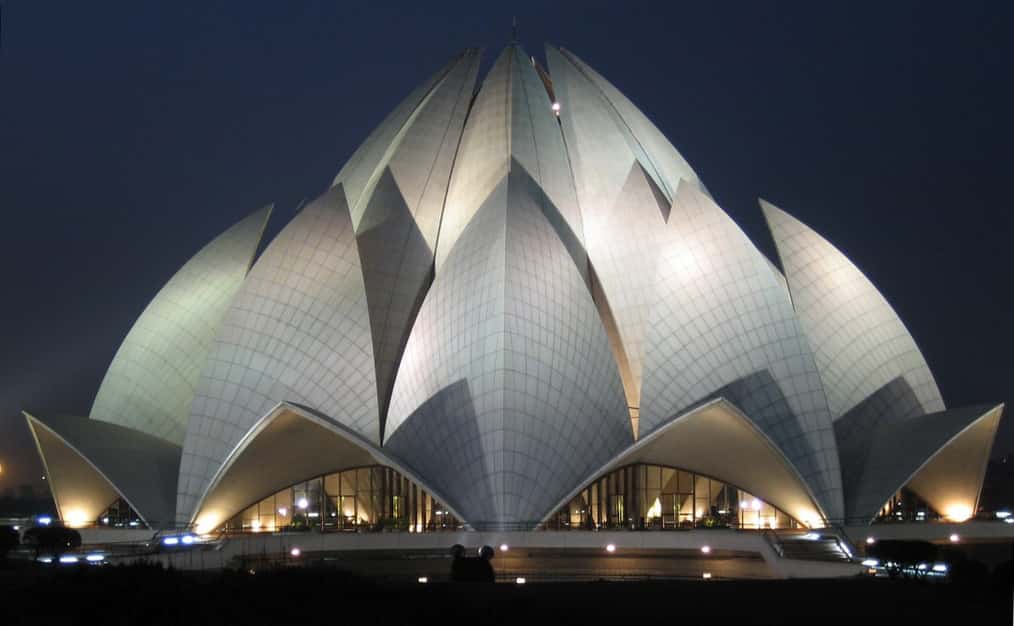
Lotus Temple Entry Fee 2026
Ticket Price: ₹0 — Completely Free
| Category | Entry Fee |
| Indian Citizens | Free |
| Foreign Nationals | Free |
| Children | Free |
| All religions, all backgrounds | Free |
| Booking required? | No — walk in directly during opening hours |
The Lotus Temple charges no entry fee to anyone. No ticket counter for general visitors. No online booking required for individuals or groups. Walk in through any of the nine entrance paths during opening hours.
Voluntary donations are accepted at a donation counter — but entirely optional.
Lotus Temple — Quick Overview
| Detail | Information |
| Official Name | Bahá’í House of Worship (Continental House of Worship for Asia) |
| Address | Lotus Temple Road, Shambhu Dayal Bagh, Bahapur, Kalkaji, New Delhi – 110019 |
| Entry Fee | FREE |
| Open Days | Tuesday to Sunday (closed every Monday) |
| Summer Timings (April–September) | 9:00 AM – 7:00 PM |
| Winter Timings (October–March) | 9:00 AM – 5:30 PM |
| Nearest Metro | Kalkaji Mandir (Violet Line + Magenta Line interchange) — ~400–500 metres |
| Photography inside prayer hall | Not permitted |
| Photography outside | Permitted freely |
| Total Area | 26 acres |
| Petals | 27 (in clusters of three; nine sides) |
| Prayer Hall Capacity | ~2,500 persons |
| Height | ~34 metres (about 112 feet) |
| Architect | Fariborz Sahba (Iranian-Canadian) |
| Completed | 1986 |
| Built With | White Pentelic marble (Greece) |
Lotus Temple Timings 2026
| Season | Opening | Closing |
| Summer (April to September) | 9:00 AM | 7:00 PM |
| Winter (October to March) | 9:00 AM | 5:30 PM |
| Closed | Every Monday — no exceptions |
Best visiting windows:
- Opening time (9:00 AM–10:00 AM): Smallest crowds; peaceful atmosphere; best for meditation and photography
- Late afternoon (4:00 PM–6:00 PM in summer): Golden hour light makes the white marble glow warm; manageable crowds; beautiful shadows on the nine reflecting pools
- Avoid: Saturday and Sunday late morning to afternoon (10:30 AM–3:00 PM) during tourist season — peak crowd density; the prayer hall fills quickly
History and Philosophy
The Bahá’í Faith
The Lotus Temple belongs to the Bahá’í Faith — a religion founded in 19th-century Persia (present-day Iran) by Bahá’u’lláh, who taught the spiritual unity of all humanity and the essential harmony among all major world religions. The Bahá’í Faith teaches that the major prophets and messengers of history — Abraham, Moses, Zoroaster, Krishna, Buddha, Jesus, Muhammad, and Bahá’u’lláh — were successive manifestations of the same divine truth, adapted to the needs of successive ages.
This theological foundation explains why the Lotus Temple has no idols, no dedicated priesthood, and no formal liturgical rituals: worship here consists of prayer, meditation, and scripture readings from any of the world’s religions. Visitors of any faith — or none — are equally welcome.
Eight Bahá’í Houses of Worship Worldwide
The Bahá’í Faith maintains Houses of Worship (called Mashriqu’l-Adhkár in Persian) on different continents, each architecturally distinct but architecturally required to have nine sides (the number nine being the highest single digit, symbolising completeness in Bahá’í numerology). The Lotus Temple serves as the Continental House of Worship for Asia. The others are in Wilmette (USA, the oldest), Sydney (Australia), Frankfurt (Germany), Panama City (Panama), Kampala (Uganda), Samoa (Western Samoa), and Santiago (Chile). A ninth temple in Papua New Guinea was completed in 2024.
The Architect and Construction
Iranian-Canadian architect Fariborz Sahba was commissioned in 1976 to design the New Delhi temple. The challenge was enormous: create a building in the shape of a lotus flower that was also structurally sound, acoustically appropriate for a prayer hall, comfortable in Delhi’s extreme climate, and beautiful at every scale from a distance and close up.
Construction took from 1980 to 1986. Over 800 engineers, technicians, and artisans worked on the project. The 27 marble petals created a geometric puzzle — each petal is a double-curved surface, and all 27 are structurally independent yet load-sharing. The marble itself was imported from Penteli Mountain in Greece — the same quarry used for the Parthenon and reportedly used for all Bahá’í Houses of Worship globally.
The building won multiple architectural awards including the Paul Waterbury Award for Outdoor Lighting from the Illuminating Engineering Society of North America (1988) and the Architectural Institute Award (1989). It has been featured extensively in architectural publications globally.
Numbers Behind the Lotus Temple
The significance of nine in Bahá’í numerology runs through every aspect of the design:
- Nine sides (grouped in three clusters of three petals each)
- Nine reflecting pools surrounding the structure
- Nine entrances into the prayer hall
- 27 petals (27 = 9 × 3)
The lotus flower as a symbol carries significance across multiple Indian religions — Hinduism (where it is associated with Vishnu, Lakshmi, Saraswati, and Brahma), Buddhism (where it represents purity and spiritual awakening), and Jainism. The Bahá’í choice of lotus form for the Indian House of Worship reflects this intentional grounding in the spiritual symbolism of the host culture.
The Prayer Hall — What Happens Inside
Entry Process
At the main gate (any of the nine entrance approaches), you pass through a security checkpoint — standard bag scanning and metal detection. Nothing about this is unusual for a major Delhi attraction.
After passing security, a Bahá’í volunteer gives a brief, low-key introduction to the temple and the Bahá’í Faith. This takes 2 to 3 minutes and is informative rather than evangelical. Then you proceed toward the main entrance.
Before entering the prayer hall, remove footwear at designated stands (staff will guide you). The marble floor is cool and smooth underfoot.
Inside the Prayer Hall
The interior is a single vast circular hall — 34 metres tall, 35 metres in diameter, with a seating capacity of approximately 2,500 people. The ceiling is the underside of the lotus structure, with sunlight filtering through the geometric gaps between petals via a steel-and-glass roof system that allows natural light while protecting from rain. The effect is soft, directionless natural illumination.
No images, no altars, no idols, no incense, no bells. Wooden benches arranged in concentric arcs. And silence — enforced by convention, maintained by the weight of the space.
Prayer sessions: Brief sessions are held periodically throughout the day at which a Bahá’í volunteer reads passages of scripture from different world faiths — the Quran, the Bhagavad Gita, the Bible, the Bahá’í writings — without commentary or instruction. Most visitors spend 10 to 15 minutes inside. Some stay longer. No one is hurried.
Photography: Not permitted inside the prayer hall. The restriction is practical as well as reverential — camera flashing in a meditative space would disrupt the atmosphere completely. Mobile phones should be silenced (or switched off) before entry.
The Nine Reflecting Pools
Surrounding the lotus structure are nine pools of water, designed as part of the natural cooling and humidity system of the building. The pools reflect the white marble structure and create the visual impression of a lotus floating on water — the botanical context the flower actually requires.
The pools and surrounding gardens are part of the 26-acre complex. Walking around the exterior and the garden between the pools is itself a significant part of the visit — the architectural views from different distances and angles reveal different aspects of the geometric composition.
Photography Guide
Outside the prayer hall: Photography is permitted entirely freely throughout the 26-acre complex — the gardens, the reflecting pools, the exterior of the lotus structure from all angles. The Lotus Temple is one of Delhi’s most photogenic landmarks and well worth extensive exterior photography.
Inside the prayer hall: No photography, period. This is enforced by staff.
Best photography positions:
- From the main approach pathway (full-front-facing view of all 27 petals)
- From the reflecting pool level (water reflection of the lotus structure)
- From the garden corners behind the structure (reveals the nine-sided geometry)
- Golden hour (4:30–6:30 PM in summer; 3:30–5:00 PM in winter) for warm marble glow
Facilities
| Facility | Detail |
| Footwear stand | At all nine entrances; free of charge |
| Drinking water | Available at multiple points |
| Restrooms | Available in the complex |
| Wheelchair access | Available for general complex; some entry approaches are ramped |
| Parking | Available in the complex; also on Lotus Temple Road |
| Visitor information centre | Available near the main entrance |
| Library | A small Bahá’í library within the complex |
How to Reach Lotus Temple
By Metro (Strongly Recommended):
Kalkaji Mandir Metro Station — an interchange station on both the Violet Line and the Magenta Line — is the closest station, approximately 400 to 500 metres from the temple main entrance (a 5-minute walk). This is the most convenient approach from any part of Delhi.
From Kalkaji Mandir station:
- Violet Line (Kashmere Gate → Raja Nahar Singh): Use Exit 4
- Magenta Line (Botanical Garden → Janakpuri West): Use Exit 1
Both exits emerge close to Lotus Temple Road. The temple is visible from the main road.
By Road:
Located on Lotus Temple Road in Bahapur, Kalkaji, South Delhi. Set destination “Lotus Temple Delhi” on Google Maps / Ola / Uber. Auto-rickshaws, DTC buses, and cabs are readily available.
By Bus:
Multiple DTC bus routes serve the Kalkaji / Nehru Place area with stops near the temple. The bus stop is called “Lotus Temple” or “Kalkaji Temple.”
Parking:
Parking available within the temple complex and on adjacent roads. Large tour buses have a dedicated area.
Nearby Attractions
| Attraction | Distance | Type |
| Kalkaji Mandir | Adjacent (across road) | Ancient Kali temple |
| ISKCON Temple, East of Kailash | ~2 km | Major Vaishnava temple + restaurant |
| Nehru Place | ~1.5 km | Electronics market |
| Humayun’s Tomb (UNESCO) | ~5 km | Mughal heritage |
| Qutub Minar (UNESCO) | ~8 km | Delhi Sultanate heritage |
Best Time to Visit
October to February: Delhi’s winter makes the outdoor garden walk genuinely pleasant and photography quality is at its peak — clear blue skies, warm marble in winter afternoon light, manageable crowds.
Early morning (9:00 AM opening): The most peaceful visit window across all seasons. The prayer hall before 10:00 AM on weekday mornings holds a calm that weekend afternoons cannot replicate.
Avoid peak hours: Saturday and Sunday late morning (11:00 AM – 2:00 PM) sees maximum crowd density. School groups tend to visit in the 10:00 AM – 12:00 PM window on weekdays during the academic year — arrive before or after this window on weekdays.
Monsoon (July–September): The reflecting pools are full and the lotus petals contrast dramatically against monsoon cloud skies. Crowds are lower than summer/winter tourist season.
Rules and Guidelines
- Remove footwear before entering the prayer hall
- Maintain complete silence inside the prayer hall — no talking, no phone sounds
- No photography inside the prayer hall
- No food or drinks inside the complex
- Modest clothing expected — no shorts or sleeveless tops inside the prayer hall
- No large bags inside the prayer hall (leave at the footwear stand)
- Pets not permitted
- Open to all religions, nationalities, and ages — no restrictions on who may enter
Frequently Asked Questions
Q1. Is there a ticket or entry fee for the Lotus Temple?
No. The Lotus Temple is completely free for all visitors — Indian and foreign, all ages, all religions. No booking required.
Q2. What are the Lotus Temple timings in 2026?
Summer (April–September): 9:00 AM to 7:00 PM. Winter (October–March): 9:00 AM to 5:30 PM. Closed every Monday.
Q3. Which metro is nearest to the Lotus Temple?
Kalkaji Mandir Metro Station — interchange for Violet Line and Magenta Line — approximately 400 to 500 metres from the main entrance.
Q4. Can non-Hindus / non-Indians visit the Lotus Temple?
Yes. The Lotus Temple is explicitly open to people of all religions, all nationalities, and all backgrounds. It is a universal place of prayer and meditation, not a Hindu or any other specific temple.
Q5. Is photography allowed inside the Lotus Temple?
Photography is freely permitted throughout the 26-acre exterior complex and gardens. No photography is allowed inside the prayer hall.